Feeds:
Posts
Comments

Posts Tagged ‘Danish’

Brunsviger

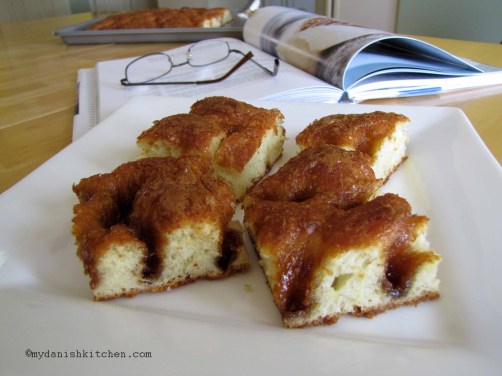
Brunsviger is a classic Danish coffee cake of sorts. It comes from Fyn (Funen) in Denmark, the island where Hans Christian Andersen was born. It is a soft yeast dough topped with a generous serving of butter and brown sugar. It’s traditionally served warm in the morning or with afternoon coffee or tea and it’s always best the same day it is made. If you have some left-over cake you can heat it up a little and it’s still delicious.
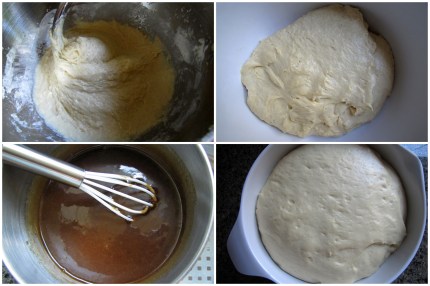
The challenge I had making this cake was that the pan size called for, was an odd size (16×20 inch) which I don’t have. So the first time I made this coffee cake I made it “free style” if you will, simply just forming it onto a baking sheet. But it resulted in a lot of the topping flowing off the cake and making a big mess in my oven. After a weeks time of pondering I gave it another shot and this time I decided to use my 9 x 13 inch pan which is not the “correct” size but it does have tall sides as oppose to the baking sheet, and I am happy to say that it worked out great. The topping stayed on top and really seeped into the cake. Make sure to make plenty of finger dimples in the cake because this is where the yummy stuff hangs out.  🙂

Brunsviger – 12 to 16 servings

Ingredients:

1 cup whole milk, warmed to 100-110 degrees F (37-43 degrees C)

4 1/2 teaspoons active dry yeast (or 50 grams cake/fresh yeast)

6 tablespoons butter, melted

2 eggs

2 tablespoon sugar

1/4 teaspoon salt

3 1/2 cups all-purpose flour

Topping:

3/4 cup packed dark brown sugar

1 cup butter

Directions:

Heat milk to to 100-110 degrees F (37-43 degrees C), sprinkle active dry yeast over milk, give a quick stir and let sit for 10 minutes. Meanwhile melt butter and set aside.

Pour milk mixture into the bowl of a stand-mixer. Add eggs, sugar, salt and melted butter, stir to combine. Using the dough hook start the mixer on medium-low speed and add the flour in small increments. Note: you may not need all the flour. Scrape down the sides of bowl with a rubber spatula as needed and continue to add the flour until dough is soft, elastic and slightly sticky. Grease a large bowl with a small amount of baking spray or vegetable oil, place dough in bowl, cover with a clean dry tea towel and let rise for 30 minutes.

Spray a 9 x 13 inch (23 x 33 cm) baking pan with baking spray and line with piece of parchment paper extending up to the edges of pan. Deflate the dough and pour into baking pan. If dough is a little too tacky cover your fingers in a light dusting of flour. Press dough evenly out into the corners of the baking pan. Cover pan with the tea towel and let rise for another 20 minutes.

Preheat oven to 400 degrees F (200 degrees C).

To make the Topping: Over low heat melt butter with the brown sugar. Stir frequently to ensure sugar is completely melted and butter in fully incorporated. Do not boil! Remove from heat and cool slightly.

Pour 2/3 of topping over dough and spread evenly. Press your fingers into the dough to make deep dimples. Pour the remaining 1/3 of topping over dough and bake for 25-30 minutes. Serve Brunsviger warm. Enjoy!

Source: adapted from The Scandinavian Cookbook

This recipe has been submitted to YeastSpotting, a wonderful site filled with recipes containing yeast.


Print Friendly and PDF

Read Full Post »

Hyldeblomst Saft

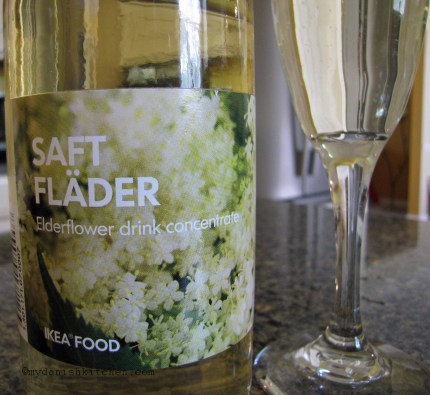
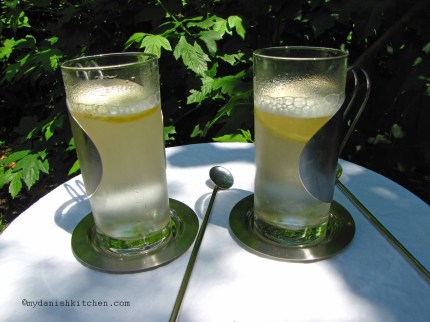
Hyldeblomster (Elderflowers) has played a big role in Nordic mythology. It was believed that the goddess Freja lived by the Elderflowers and that the bushes provided protection from evil. The flowers were also thought to give relief from ailments such as toothaches, fevers, depression and insomnia. In today’s modern Denmark Elderflowers are still very popular but for different reasons. Today the mature flowers are used to make a wonderful tasty juice concentrate. The Elderflower bushes can be found growing wild in the woods, fields or parks and the time to harvest the fragrant flowers is in early June. I have never come across Elderflowers here where we live, then again, I haven’t really gone scavenger hunting for them either. In any case, I did come across some delicious Elderflower concentrate at my all-time favorite store IKEA and wanted to share with you this refreshing drink which is perfect for the hot summer days here in Virginia.

Hyldeblomst Saft – Elderflower Concentrate

Ingredients:

Makes 1 glass

Hyldeblomst (Elderflower) with Water

1/4 cup Elderflower concentrate

3/4 cup ice-cold water

ice cubes

lemon slice

Hyldeblomst (Elderflower) with Carbonated Water (and Rum)

1/4 cup Elderflower concentrate

3/4 cup carbonated water (such as Perrier)

ice cubes

1 shot Captain Morgan’s Spiced Rum (optional)

Directions:

Making sure the water or carbonated water is ice-cold, mix with concentrate. Add ice cubes and remaining ingredients such as lemon slice and rum if desired. Enjoy!

Hyldeblomst Saft mixed in blender with ice.

Source: My Danish Kitchen

Print Friendly and PDF

Read Full Post »

Kammerjunker – Twice Baked Biscuits

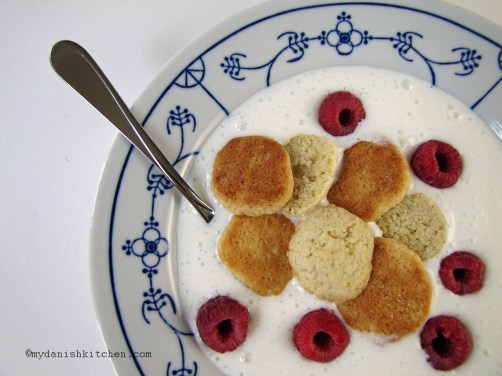
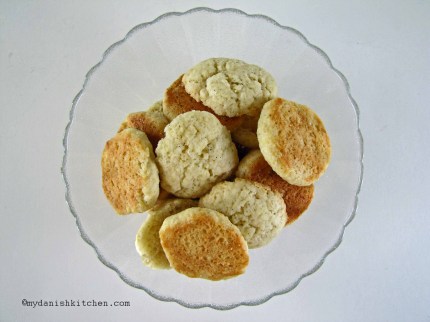
Kammerjunker is a small twice-baked biscuit which is served with the Danish summer dish KoldskĂĄl. I have been promising to write a post about Kammerjunker for quite some time now and with summer right around the corner I find myself day-dreaming about cold, sweet and tart delicious KoldskĂĄl with some crunchy homemade Kammerjunker. And so here they are!

Kammerjunker – Twice baked biscuits

I have to say that the home-made Kammerjunker completely beats the store-bought kind. These turned out crunchy and so tasty that I had to fight off my husband for them. Btw he told me to tell you that they are also great with a little jam and Nutella on them (shaking her head in disbelief). They are not overly sweet like the ones from the store, which I really like, besides I find the store-bought kind more like a cookie anyway. I hope you enjoy these as much as we have.

Kammerjunker – makes 48 whole or 96 half sliced biscuits

Ingredients:

250 grams all-purpose flour (8.8 oz.)

2 teaspoons baking powder

100 grams sugar (3.5 oz.)

1/2 vanilla bean

1/2 teaspoon cardamom

100 grams butter, room temperature (3.5 oz.)

1 egg

1/2 deciliter milk (1.7 oz.)

Directions:

Scrape the seeds from the vanilla bean and mix with a small amount of the sugar to separate the seeds. In a large bowl add flour, baking powder, sugar, seeds from vanilla bean and cardamom, stir to combine. Cut butter into pieces, add to flour mixture and using your clean hands work butter and flour together until crumbly. Add egg, mix only until incorporated. Add milk and mix only until dough comes together. Wrap dough in plastic wrap and place in refrigerator for 1 hour.

Preheat oven to 345 degrees F (175 degrees C). Line two large baking sheets with parchment paper and set aside.

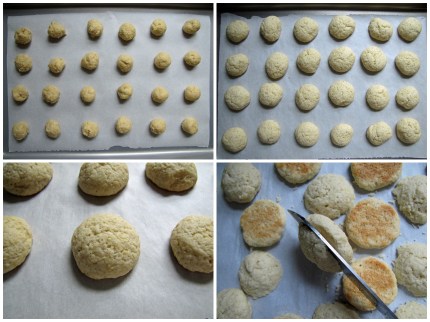
Roll small pieces of dough into approx. 2 centimeter (0.8 inch) balls and place on baking sheet 2 centimeter apart. Bake for max 10 minutes. Remove from oven and while biscuits are still warm slice into halves using a serrated knife. Place back onto baking sheet with cut-side down.

Lower heat in oven to 200 degrees F (100 degrees C) and continue to bake for another 45 minutes to dry biscuits out. Allow to cool completely before storing Kammerjunker in a cookie tin. Enjoy!

Source: adapted from Det Søde Liv

Print Friendly and PDF

Read Full Post »

Danish Birkes

Up until the time I decided to make Birkes, I thought there was just one type of Birkes. But that is not the case at all. When I started researching recipes I discovered three different kinds of this super delicious Danish pastry.

I was born and raised in a part of Denmark called Jylland where the pastry is referred to as Birkes or Thebirkes. This Birkes does not have a Remonce filling and the pasty at our house was always sliced in half and topped with jam or cheese…super delicious! My search lead me further east to Sjælland which is the island where Copenhagen (København) is located. Here the pastry is called Københavnerbirkes or Thebirkes and the wonderful people in the Copenhagen area makes the pastry with a Remonce filling…equally wonderful in its own way. Grovbirkes, as far as I can tell, can be found throughout Denmark and it is made with a healthy portion of flaxseed, sesame seeds and/or sunflower seeds…this one I have never tasted.

My favorite is the Birkes without Remonce, I guess because it’s the one I grew up with. The Birkes is flaky and buttery in the best true Danish style. The Københavnerbirkes is sweeter in taste, and as far as I can tell, the pastry is eaten as-is. There is a lot of conversation going on out there in Cyber-land about Birkes vs Københavnerbirkes and I was surprised to find out that people from one end of the country to the other, is not really aware of the other kind of Birkes. When I called my parents to ask them about Birkes with a Remonce filling my mother said that she had never heard of “such a thing”, so apparently I am not the only one 🙂

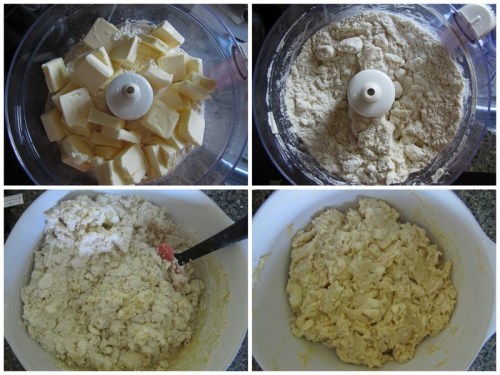
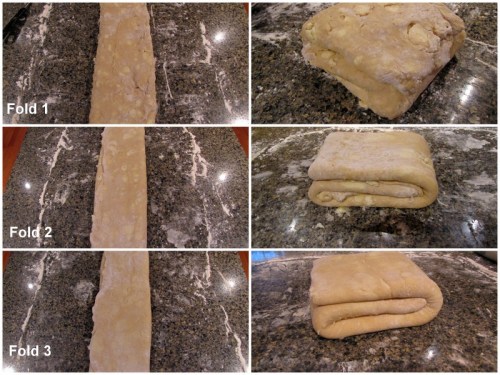
Notice the clumps of butter in the two pictures on the right. The butter should be the size of kidney beans.

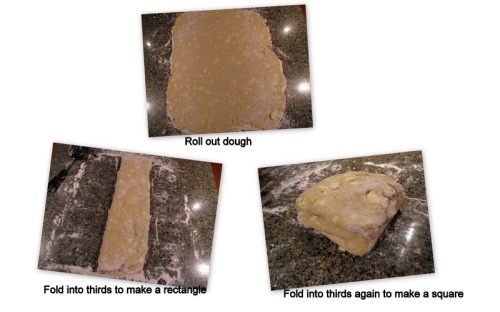
Rolling and folding process.

The dough is rolled out, then folded into thirds and folded into thirds again.
This process in repeated three times. Notice how you still see the butter in the dough.

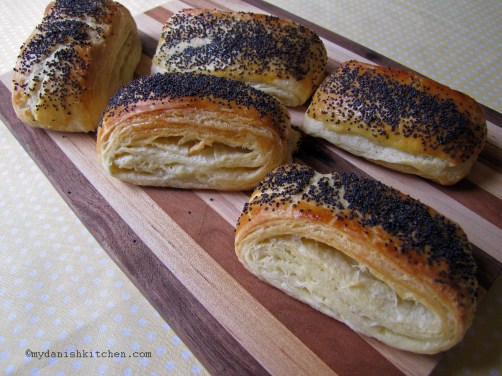
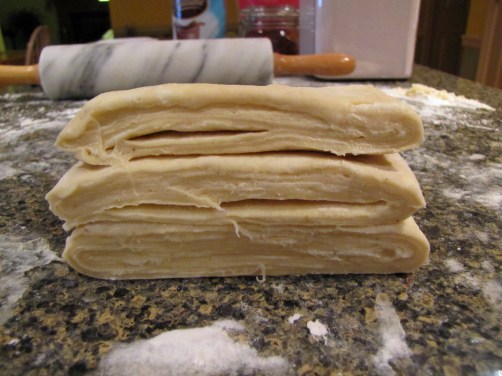
Puff pastry (Butterdej) with all its wonderful layers!

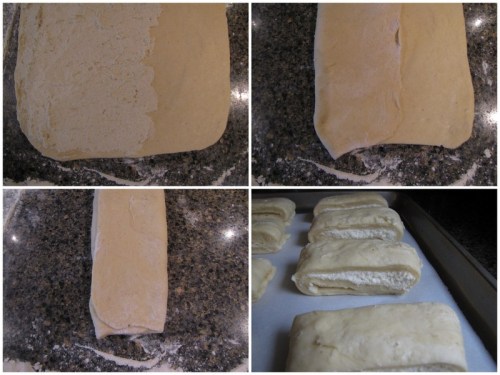
If making Birkes with Remonce, spread remonce over 2/3 of dough, fold into thirds and cut into 2 inch rectangles.

Note: after I filled with Remonce, I placed the dough on the baking sheet upside down so the filling was towards the top. I think this may have resulted in the Birkes that had the filling in them, turned out like The Leaning Tower of Pisa. So try to place them on the baking sheet with the filling towards the bottom.

Makes 2 portions of Puff Pastry dough (Butterdej).

Ingredients:

For the dough:

3 1/2 cups flour (15 3/4 oz) (450 grams)

1 1/2 cups cold unsalted butter (12 oz) (340 grams)

4 1/2 teaspoons active dry yeast (or 50 grams cake/fresh yeast)

1/2 cup warm water (4 oz) (118 ml) (100 – 110 degrees Fahrenheit)

1/2 cup heavy cream (4 oz) (118 ml)

1/2 teaspoon cardamom

1/2 teaspoon salt

2 eggs, room temperature

1/4 cup sugar (1 3/4 oz) (55 grams)

For Remonce filling: optional

2.8 oz butter (80 grams) at room temperature

2.8 oz sugar (80 grams)

2.8 oz marzipan (80 grams) at room temperature

For final assembly:

1 egg, slightly beaten for brushing

Poppy Seeds for sprinkling

Directions:

Place flour into bowl of food processor with steel blade. Cut cold butter into 1/4 inch slices and add to flour. Pulse flour and butter until the butter is the size of kidney beans.

In a large bowl, dissolve the yeast in the warm water. Let stand 10 minutes. Stir in the cream, cardamom, salt, eggs and sugar and mix until combined using a fork. Using a rubber spatula, turn the flour/butter mixture into the liquid and carefully mix just until the dry ingredients are moistened. Cover and refrigerate for 4 hours, overnight or up to 4 days.

Turn the dough out onto a lightly floured surface, dust top of dough with flour. Roll out dough to make a 16 to 20 inch rectangle. Fold dough into thirds, rotate dough a quarter of turn and fold into thirds again, making a small square. Turn over dough. Repeat rolling and folding another two times (making it a total 3 times of rolling and folding), ending with a small square. Using a sharp knife cut dough into two halves. Wrap each 1/2 portion of dough in plastic wrap, place both dough portions in a plastic bag and chill for at least 30 minutes.

Refrigerated dough is now divided into 2 halves. Each half of dough will make 10 birkes rolls. If you are not using the second half of dough, it can be frozen for later use. Defrost in refrigerator for 24 plus hours before using.

If using the Remonce filling, make it at this time. Use a hand-held mixer, beat the butter, sugar and marzipan to a smooth soft spreadable cream. Set aside.

Remove first half of dough from refrigerator and place on a lightly floured surface, dust top of dough with flour. Roll dough out to a 12 x 18 inch rectangle. If using Remonce filling, spread a thin layer of the filling over 2/3 of the long edge of dough. Starting with the long edge that has the filling, fold 1/3 of dough over the middle. Then fold the remaining 1/3 of dough without filling over the middle, the dough is now folded into 3 layers. Using a sharp knife, cut dough into approximately 2 inch rectangular pieces. Place pieces of dough onto a baking sheet lined with parchment paper. Allow to rise for 20-30 minutes.

Preheat oven to 350 degrees F (180 degrees C). Lightly beat egg and brush onto top of dough. Sprinkle with poppy seeds. Bake for 15-20 minutes or until golden brown. Allow Birkes to cool on baking sheet. Birkes with Remonce filling is eaten as is. Birkes without filling is sliced in half and topped with jam or cheese. Enjoy

Source: My Danish Kitchen

This recipe will be submitted to YeastSpotting.

Print Friendly and PDF

Read Full Post »

Ymerdrys

Ymer is a Danish milk product that was developed in the 1930’s. It’s similar to yogurt and buttermilk and it’s often served as a breakfast, snack or dessert. Unfortunately Ymer cannot be purchased in the US but I find that Greek Yogurt is a great substitute.

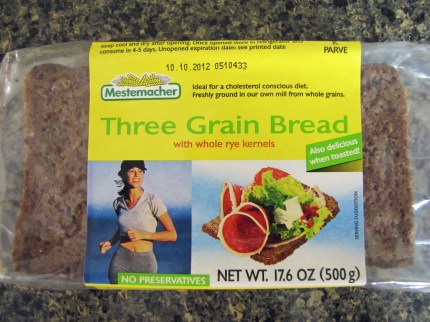
Rugbrød (Rye Bread)

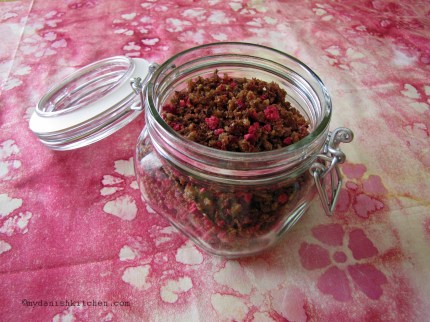
Ymerdrys is a topping that is sprinkled on top of the Ymer. It is made from Danish Rugbrød (Rye Bread) and the tart and sweet taste of the bread is a perfect compliment to the slightly sour Ymer. Many years ago I purchased Ymerdrys online but I was very disappointing because it was much too sweet. Then recently I came across homemade Ymerdrys, but could it be as good as what I remember from home? Yes it can! And it is very quick and easy to make 🙂

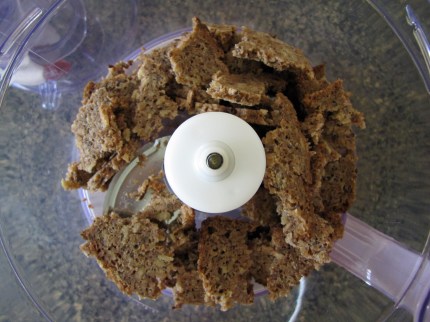
Rugbrød (Rye Bread) crumbs

Ymerdrys is definitely one of those foods that I’ll be making on a regular basis. It’s a great source of fiber, a delicious addition to your Ymer or Yogurt and a great way to use up leftover Rugbrød. Now, Ymerdrys from back home did not have freeze dried berries in it, so that is completely optional, but I just wanted a little extra color in it and I had a bag of freeze dried raspberries sitting around waiting to be used up, besides it turned out ĂĽber good. Also, when you choose your Rugbrød I would recommend choosing one that has some seeds into, it gives a little extra crunch after it’s baked.

Ymerdrys with dried raspberries

Ingredients:

200 gram Rugbrød (7 1/2 oz Dark Rye Bread)

2 tablespoons brown sugar

1/4 to 1/2 cup freeze dried raspberries, optional

Directions:

Preheat oven to 375 degrees F (190 degrees C)

Break Rye Bread into large chunks and place in a food processor. Add brown sugar. Pulse until desired consistency. Place bread onto a baking sheet lined with parchment paper and bake in oven for 10-15 minutes. Watch it closely the last 5 minutes to make sure it doesn’t burn. Allow to cool on baking sheet. Place freeze dried berries into a small plastic bag and crush into small chunks. Add berries to Rye Bread and mix. Enjoy sprinkled over top of your Ymer or Greek Yogurt!

Rugbrød

Source: adapted from Miras Madblog

Print Friendly and PDF

Read Full Post »

Varme Hveder aka Hvedeknopper

It’s an old Danish tradition to eat warm Hveder Thursday evening before Store Bededag (Big Prayer Day), which is on the fourth Friday after Easter (May 4th 2012). Store Bededag was introduced in 1686 to consolidate the number of prayer days that could otherwise be used as productive working days. The tradition is from a time when Store Bededag was a work free day and this included the bakers. So the bakers made Hveder the day before Store Bededag for the people to buy and they could then toast and eat them the following day when the bakeries were closed. However, somehow the tradition turned out that people ate the Hveder the night before, perhaps because they are so good.

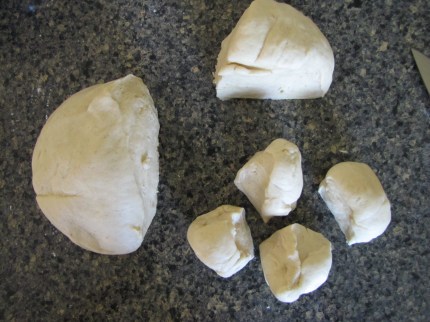
Hvede dough

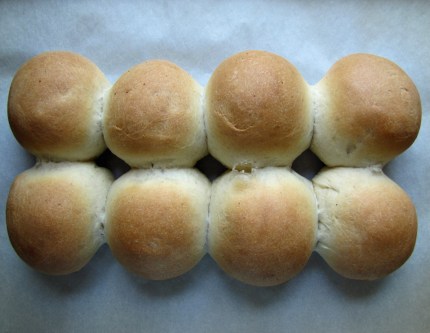
Today fresh Hveder can still be found in all baker shops, in the days leading up to Store Bededag or you can bake them yourself. The buns are meant to be eaten when they are warm and toasted which really brings out the flavors. When they are cold they seem a bit dull and heavy. You can top them with butter, jam, cheese or cold cuts. I hope you enjoy these Danish Hveder as much as I have, it brings back wonderful memories for me. 🙂

Varme Hveder

Hveder – makes 16

Ingredients:

125 gram butter (4 1/2 oz or ~9 tablespoons)

4 teaspoons active dry yeast (or 50 grams cake/fresh yeast)

3 deciliter milk (10 oz or ~ 1 1/4 cup)

1 egg

1 tsp salt

1 1/2 tsp sugar

1 1/2 tsp ground cardamom

650 gram all-purpose flour (5 cups or 1 lb 7 oz)

1/2 deciliter milk – for brushing (~1 1/2 oz)

Directions:

Melt butter and set aside to cool down. Warm milk in microwave to 100-110 degrees F, add dry yeast to milk and let sit for 10 minutes.  In the bowl for your stand mixer fitted with the hook attachment add butter and milk/yeast mixture. Start mixer on low, add egg, salt, sugar and cardamom. Add flour in small increments until dough starts to come together (Note: you may not need all the flour). Place dough on a lightly floured surface and give it a quick needing to ensure it is homogeneous. Place dough in a large bowl, cover with a dry and clean tea towel and allow to rise for 30 minutes. Prepare a large baking sheet with parchment paper and set aside.

Place dough onto a lightly floured surface. Divide into 16 equal portions, by first dividing the dough into half and then into halves again and so on. Shape dough pieces into balls by folding the edges under and into the center until they are round. The small opening at the bottom is placed down on the baking sheet. Space dough balls 1 centimeter apart (almost 1/2 inch). Cover balls with tea towel and let them rise for 30 minutes. As they rise, they will start to grow together, this is what you want. Preheat oven to 200 degree C (390 degrees F).

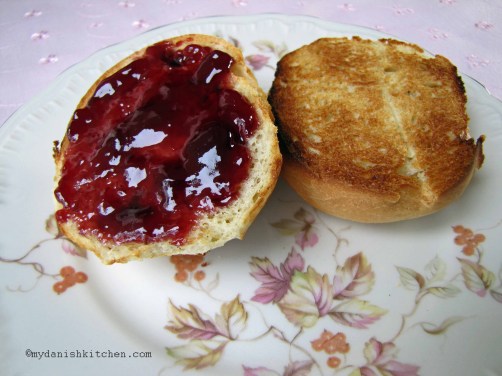
Once risen, brush rolls with a little milk and bake for 15-20 minutes until golden brown. Allow to cool. To serve Hveder, cut in half and toast them. Top with butter or jam, cheese, cold cuts etc. Enjoy!

Note: Dough can easily be frozen after they are formed into balls by placing in a freezer safe bag. Once ready to use, defrost in refrigerator. Allow rolls to come to room temperature and then rise for 30 minutes before baking.

This post will be linked to YeastSpotting!

Source: slightly adapted from Kvalimad

Other sources: Naturbageriet

Print Friendly and PDF

Read Full Post »

Citronfromage

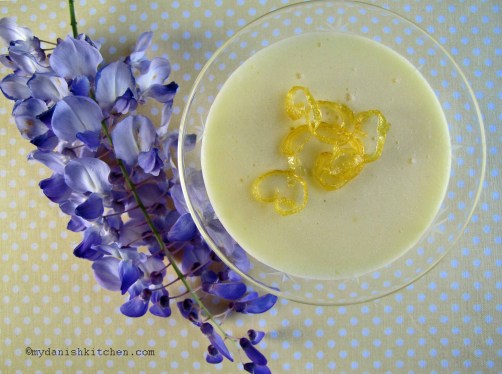
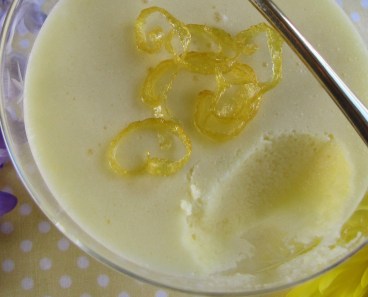
Citronfromage is a classic Danish dessert, a familiar old friend to all Danes. It can of be served any time of the year but I associate it with long summer days when the sun sets late in the evening. The mousse is a beautiful pale yellow color and it is filled with air making it a very light dessert. The tart lemon flavor is complimented with sweet whipped cream which gives it nice contrast. Make sure to serve the Citronfromage cold with a dollop of whipped cream and enjoy!

Disclaimer: this recipe is made with raw eggs, and as we all know, these days eating raw eggs is frowned upon due to a potential risk of salmonella food poisoning.  You can certainly use pasteurized eggs for this dessert but I chose to use fresh eggs lade the old fashioned way by a happy chicken. For more info on safe handling of eggs check out this FDA site, it has a lot of good information.

Citronfromage: serves 6

Ingredients:

For the Mousse:

1 tablespoon granulated gelatin

3 tablespoons cold water

3 organic lemons, juiced

1 teaspoon lemon zest

3 eggs, separated

1/3 cup superfine sugar

generous 1/3 cup heavy cream

For Serving:

1/2 cup heavy cream

1 tablespoon confectioners sugar

For Candied Lemon Zest:

1 lemon

1/3 cup superfine sugar

1/4 cup water

Directions:

To make the Mousse: Place gelatine and cold water in a heat-proof bowl and let sit for 5 minutes. Meanwhile in a small bowl, using an electrical mixer, beat the egg yolks and sugar until thick and pale in color. In the bowl of your stand-mixer with the whisk attachment (or using a large mixing bowl with clean beaters), whisk the egg whites until stiff peaks form. In another bowl beat the heavy cream until soft peaks form.

Place the bowl with the softened gelatin over small saucepan of simmering water to melt gently. Once gelatine is melted, add lemon juice and zest. While continuing to beat the egg yolks, add the gelatine/lemon mixture in a thin stream. Fold the stiff egg whites and whipped cream into the egg/gelatin mixture until smooth. Pour into individual serving dishes or a large serving bowl, cover with plastic wrap and place in refrigerator to set for at least 3-4 hours.

To make Candied Lemon Zest: Using a zester, cut the peel from the lemon into long strips. Squeeze the juice from the lemon and set aside. In a small saucepan add water, sugar, lemon juice and lemon peel, bring to a boil and continue to simmer for 5 minutes. Remove the lemon strips from the hot liquid. Separate the lemon strips from each other and spread them out on a baking sheet, allow to cool.

To serve: whip the remaining 1/2 cup heavy cream with confectioners sugar until soft peaks form. Serve the lemon mousse cold with the whipped cream and candied lemon zest. Enjoy!

Citronfromage

Source: adapted from The Scandinavian Cookbook

Print Friendly and PDF

Read Full Post »

Mazarinkage

You’re probably all wondering, why does she keep posting recipes with marzipan? Well, all I can say is that marzipan is immensely popular in Denmark and it’s a natural part of baking (and besides….I like it)

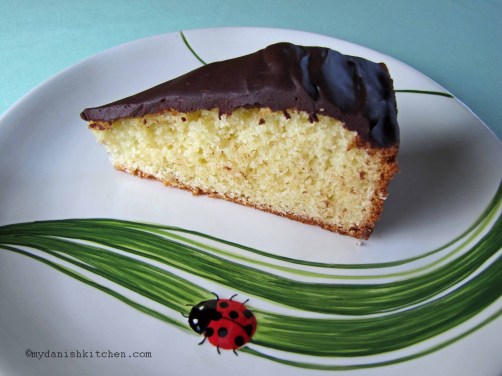
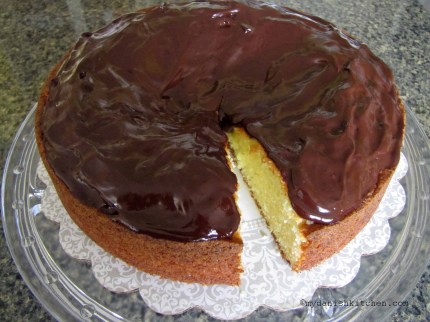
Mazarinkage is a classic Danish cake found in most bakeries. It’s a sponge cake made with Marzipan which makes the cake moist, sweet and compact. There are many different variations of this cake. Some make it with orange juice/mashed oranges, amaretto or with a nougat glaze instead of the chocolate ganache, all sounding very enticing. But for this post I wanted to keep it close to the way I remember the cake, simply delicious.

Mazarinkage - The ganache is still moist in this picture, and yes I stole a piece of cake before putting the ganache on 🙂

Ingredients:

For the dough:

100 grams all-purpose flour (3 5/8 oz)

100 grams cornstarch (3 5/8 oz)

1 tablespoon baking powder

200 grams butter, melted (7 1/4 oz)

200 grams marzipan, grated (7 1/4 oz)

4 eggs

200 grams confectioners sugar (7 1/4 oz)

For the ganache:

100 grams semi-sweet chocolate, chopped (4 oz)

1 deciliter half and half (3.4 oz or 0.4 cup)

Directions:

Preheat oven to 350 degrees F (180 degrees C).

In a medium bowl, add flour, cornstarch and baking powder, set aside. In a small saucepan melt butter and set aside to cool. Grate marzipan and set aside.

In the bowl of a stand-mixer, with the speed on medium, beat eggs and confectioners sugar. While continuing to beat, add cooled butter in a thin stream.  Add marzipan and then add remaining dry ingredients.

Spray with baking spray or butter a round 9 inch (23 cm) spring-form pan. Pour dough into spring-form and bake 35 to 40 minutes. Allow to cool on a cooling rack.

To make ganache: Add half and half  and chopped chocolate to a small saucepan. Over medium-low heat melt chocolate, stirring frequently until mixture starts to thicken. Remove cake from spring-form and spread ganache over top of cake. Enjoy!

Source: adapted from Kvalimad

Print Friendly and PDF

Read Full Post »

Rundstykker

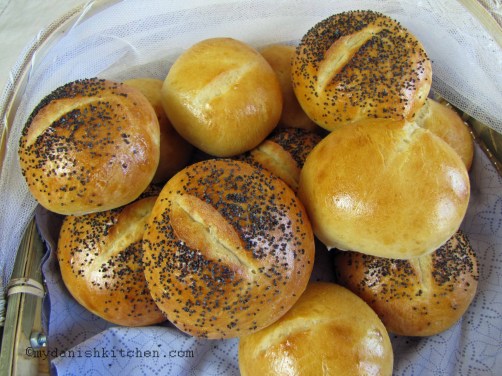
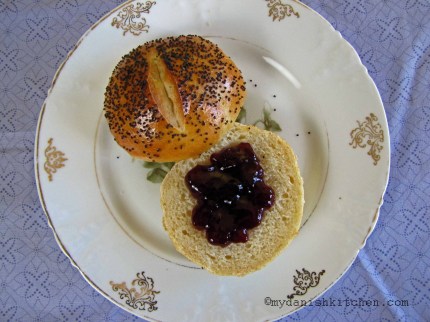
Rundstykker is a Danish breakfast buns and literally means “round pieces”. They are immensely popular, and dare I say, sold in every single bakery in Denmark. When I was younger and lived at home, my Dad would always get up early on the weekends, jump on his bicycle and ride to the baker to pick up some fresh Rundstykker. We would eat them with jam, cheese, honey or Nutella and they were wonderful.

Rundstykker

Living away from Denmark I only got to eat Rundstykker when I was home visiting. But why not make them myself? It turns out that they are fairly easy to make and the aroma of fresh baked bread on a weekend morning is simply just amazing. I will eat them warm right out of the oven or cooled off, either way, they are delicious and brings back memories of distant weekend mornings at home.

Rundstykker – 12 servings

Ingredients:

25 grams butter (3/4 ounces)

3 deciliter milk (11 ounces)

4 teaspoons active dry yeast (or 50 grams cake/fresh yeast)

400 grams flour (14 ounces)

1 teaspoon salt

poppy seeds

1 beaten egg for brushing

Directions:

Add butter to a small saucepan and melt over low heat, add milk and heat until between 100-110 degrees F (37 – 43 degrees C). Sprinkle the active dry yeast over the warm milk and let sit for 10 minutes.

Mix together flour and salt in a bowl. Pour milk/yeast mixture into the bowl of stand mixer fitted with the hook attachment. Starting on low, add the flour in increments. (If dough is still sticky after all the flour has been added, you can add a little extra flour until dough is no longer sticky). When all flour has been added, mix on medium speed for 10 minutes. (The mixing and kneading process can certainly be done by hand, make sure to knead the dough for 10 minutes as well, if you choose to do it by hand). Place dough in a bowl and cover with clean, dry tea towel. Place in a warm, draft free spot and allow to rise until double in size, 30-45 minutes.

Line two baking sheets with parchment paper and set aside. Pour dough out onto a lightly floured work surface. Divide dough into 3 equal portions. Then divide each of these portions into 4 equal parts for a grand total of 12 small pieces. Roll each piece of dough into a small dough ball, place 6 dough balls on each baking sheet. Cover each baking sheet with a clean, dry tea towel and allow to rise in a warm location for 30 minutes.

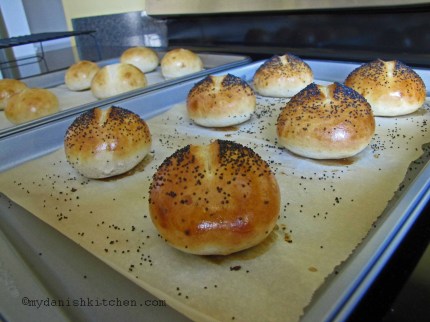
Preheat oven to 440 degrees F (230 degrees C). After the dough balls have finished rising, brush with beaten egg and sprinkle with poppy seeds. For additional decoration, using a sharp knife, cut a slit in the top of each dough ball. Bake for 10 – 12 minutes or until golden brown. Allow to cool completely or serve warm with your favorite topping. Enjoy!

This post has been submitted to YeastSpotting.

Source: adapted from Kvalimad.dk

Print Friendly and PDF

Read Full Post »

Fastelavnsboller

Fastelavn (Shrovetide) is right around the corner in Denmark and so this time of year you see these wonderful fresh-baked filled rolls everywhere. I have posted about the Danish Fastelavn tradition before but I think the Fastelavnsboller is totally worth revisiting, especially since they are one of my favorite Danish treats. 🙂 If your curious to learn more about this fun tradition for the children check out my previous post on Fastelavnsboller here.

Fastelavnsboller

These particular Fastelavnsboller are lighter in texture than my previous recipe. The dough is soft and elastic and very easy to work with. Also there is no rolling out the dough. Simply just divide the dough into smaller portions, roll in your hands, then flatten and fill. Easy peasy!  I choose to do several different fillings. I made a delicious kagecreme (custard) and I also used seedless raspberry jam and Nutella.

Ingredients:

For Fastelavnsboller dough:

2 deciliter milk (7 ounces)

4 teaspoons active dry yeast (or 50 grams cake/fresh yeast)

50 grams sugar (1.7 or 1  3/4 ounce)

1/4 teaspoon salt

1 teaspoon ground cardamom

1 teaspoon vanilla sugar

1 deciliter heavy whipping cream (3.3 ounces)

125 grams butter, melted (4.4 or 4 3/8 ounces) or (8.4 tablespoons)

500 grams all-purpose flour (1 pound + 2 ounces) or (4 cups + 2 tablespoons)

1 beaten egg for brushing

seedless raspberry jam, for filling, if using

Nutella, for filling, if using

For Kagecreme (custard), for filling, if using:

1 deciliter heavy whipping creme (3.3 ounces) or (0.4 cup)

1 1/2 deciliter milk (5 ounces) or (0.6 cup)

50 grams sugar (1.7 or 1 3/4 ounce)

2 whole eggs

1 vanilla bean

2 tablespoon cornstarch

For the Icing:

1 cup confectioners sugar

warm water

food color, if desired

Directions:

Heat the milk to between 100-110 degrees F (37-43 degrees C) and sprinkle active dry yeast over the warm milk, let sit for 10 minutes. I do this in the bowl of my stand mixer. Melt butter and add cream to butter, set aside. To the yeast mixture add sugar, salt, cardamom, vanilla sugar and butter/cream mixture. With the dough hook in place start mixing on medium-low adding the flour in increments. Mix until a ball of dough forms. Place dough in a large bowl, cover with plastic wrap or a clean tea towel and place bowl in a warm draft free area. Allow dough to rise for 1 hour or until double in size.

Meanwhile make the Kagecreme (custard), if using. Mix together the creme and milk, pour into a saucepan, holding back 1/4 cup of the liquid. Add the cornstarch to the 1/4 cup liquid and stir to combine, set aside. Add sugar, eggs, seeds from vanilla bean + vanilla bean pods. Over medium low heat, whisking frequently, add the remaining 1/4 cup cornstarch liquid mixture. Continue to whisk until liquid starts to thicken and simmer. Remove from heat, discard vanilla bean pods and place in a small bowl. Cover with plastic wrap directly on the surface of the custard to prevent skin from forming. Place in refrigerator to cool

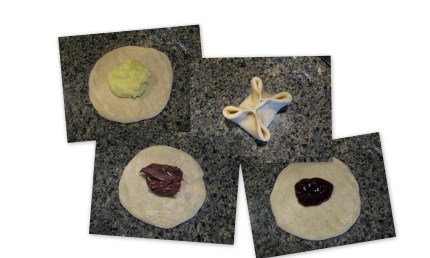
Back to the dough. Cover two large baking sheets with parchment paper and set aside. Beat egg for the egg wash and set aside. Pour dough out onto a lightly floured work surface. Briefly knead the dough. Cut the dough into 12 equal portions. Using your hands, roll first piece of dough into a ball, place on work surface and flatten with the palm of your hand spreading it into a 5 inch (13 centimeter) circle. Place filling of your choice onto circle of dough. Brush the edge of circle with egg wash to act as a glue. Fold four edges up to the center and press to seal all edges, letting the air inside escape. Brush a little more egg wash over the seam, turn the dough ball over, tuck under all edges and place on baking sheet with seam side down. Repeat with remaining dough pieces.

Preheat oven to 375 degrees F (190 degrees C). Allow filled dough balls to rise on the baking sheets, covered with clean tea towels, for 30 minutes. Right before baking, brush dough balls with remaining egg wash. Bake for 12-15 minutes or until golden brown.

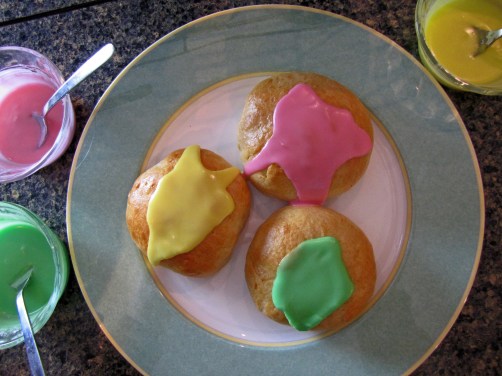
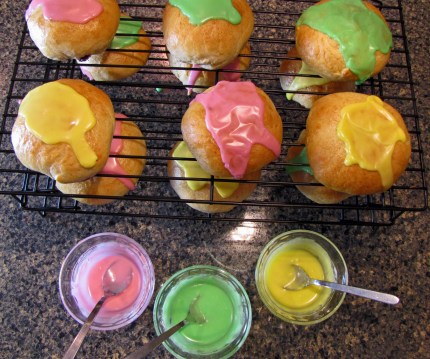
To make the icing, mix together confectioners sugar with a little warm water at the time, stirring until smooth. Glaze should be somewhat thick but spreadable. Add food color if desired. Enjoy!

Source: adapted from Maden I Mit Liv

Read Full Post »

« Newer Posts - Older Posts »