Feeds:
Posts
Comments

Archive for 2012

Lagkagebunde

When it’s a special occasion like a Birthday or an Anniversary or perhaps company is just coming over for a visit, what do you make for dessert? Well in Denmark Lagkage would be a very typical choice. And in Denmark it doesn’t take too much planning either because if you don’t have the cakes for the Lagkage you could just run to the grocery store and pick up a couple. However, living across the ocean, Lagkagebunde (individual cakes for making layered cakes) is not readily available in the stores where I live. I could buy some online and throw them in the freezer for a rainy day or I could bake them myself. When I came across Himmelske Kager’s write-up on making your own Lagkagebunde I figured it was worth a try. She has a really nice tutorial and a lot of helpful tips, not to mention that her cake is delicious.

Draw an outline of pan and place cut-out inside.

It is important that you use the correct size pan and that you follow the instruction not to grease the sides of the pan. This way you’ll get a really nice outcome. The cake itself is really easy to make, but do make sure that your eggs are at room temperature.
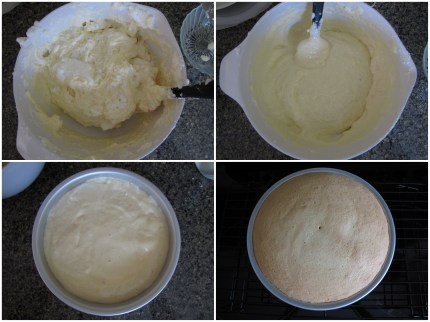
Lagkagebunde (makes 1 cake, cut into 3 thin cake layers)

Ingredients:

5 eggs, at room temperature, separated into yolks and whites

120 gram sugar

100 gram all-purpose flour

15 gram cornstarch

1 teaspoon baking powder

Directions:

Using an 8 inch cake pan, butter the bottom of the pan only. Do not butter the sides of the pan as this will ensure the cake rising straight up. Trace a circle of the bottom of the pan onto parchment paper and cut the circle out. Place the parchment paper circle onto the greased bottom of pan and set the pan aside.

Preheat oven to 340 degrees F (175 degrees C)

Making sure eggs are at room temperature, separate into yolks and whites. Place the egg yolks into a bowl, add sugar and beat until it becomes a pale yellow, thick mixture.

In another clean bowl or stand-up mixer, beat the egg whites until stiff.

Sift the flour, cornstarch and baking powder into the egg yolk mixture, beat until it’s homogeneous. Add the stiff egg whites and gently fold into the egg yolk mixture. You do this by cutting down the middle of mixture with your spatula and folding it over the other half, rotating the bowl 1/4 turn each time, repeat until fully incorporated.

Pour batter into prepared cake pan and bake for 30-40 minutes. Do not open oven door the first 30 minutes. Careful not to over-bake the cake. It’s done when the cake feels firm to the touch or test by inserting a toothpick into the middle of the cake, the toothpick should come out clean.

Let the cake cool in the cake pan on a baking rack. Once cooled, run a small knife around the edges to loosen it from the pan and turn it out upside-down onto the baking rack. Make sure cake is completely cooled before cutting it into 3 cake layers. If you are not using the cake layers right away they can be frozen. Separate the three cakes with parchment paper and store in freezer safe bags.

Variations in taste:

Add 2-3 tablespoons of finely ground almonds to batter.

Replace 2 tablespoons flour with 2 tablespoons unsweetened cocoa. Add cocoa with dry ingredients.

Add 2 tablespoons coconut to batter.

Add orange zest to batter.

Cake will fall a little while cooling, turn out up-side-down onto cake rack.

Source: Himmelske Kager

Print Friendly and PDF

Read Full Post »

Drømmekage

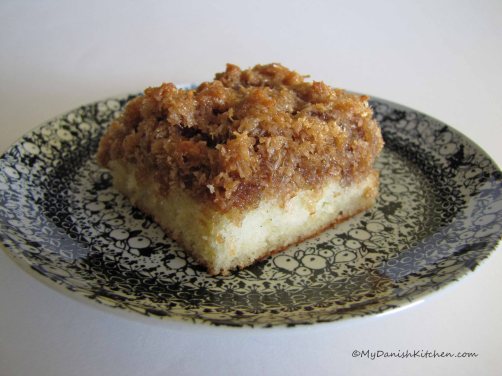
This Danish Drømmekage is like a sweet dream indeed. The cake itself is soft and spongy and loaded with vanilla beans while the topping is thick and soft with a caramel, coconut flavor that lingers on your taste buds. Note that the cake is even more dreamy the following day.

Drømmekagen is not a cake that I grew up with although it’s been around since the 1960’s. The first time I tasted it was one year my parents were visiting me here in the States and my mother and I made it for the Danish Ladies dinner party. At the time the only kind of coconut I had access to was the sweetened large chunky kinda coconut, which turned out OK but not the way it was supposed to be. So not too long ago I came across this wonderful shredded, unsweetened coconut in the grocery store and I have been thinking about remaking the cake ever since. So here it is and I hope you enjoy it as much as we have.

Drømmekage (9-12 servings)

Ingredients:

For the dough:

75 gram butter (2.6 oz.)

1 deciliter milk (3.4 oz. or 1/2 cup)

125 gram all-purpose flour (4.4 oz.)

1 teaspoon baking powder

2 eggs, at room temperature

125 gram sugar (4.4 oz.)

1 vanilla bean, seeded

1/4 teaspoon salt

For the topping:

150 gram butter (5.3 oz.)

250 gram brown sugar (8.8 oz.)

1/2 deciliter milk (1.7 oz. or 1/4 cup)

200 gram shredded unsweetened coconut (7 oz.)

Directions:

Preheat oven to 195 degrees C (380 degrees F). Spray a 9 x 9 inch baking pan with baking spray. Add 1 tablespoon flour to pan, shake flour around pan to coat bottom and sides, discard excess flour, set pan aside.

In a small saucepan add butter and milk, warm over low heat until butter is melted, set aside.

Sift together flour and baking powder, set aside.

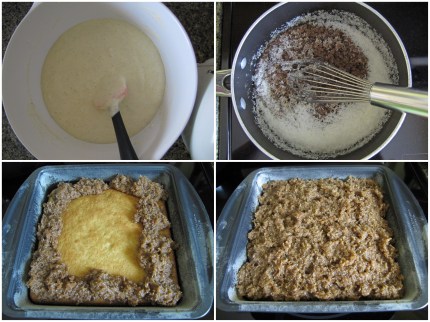
In a large mixing bowl add eggs and sugar, beat on high until mixture is pale yellow and very thick (5-10 minutes). Add vanilla beans and salt and beat until well incorporated. Add 1/2 of sifted flour mixture to eggs and, with a spatula, gently fold the flour into the eggs until smooth. Add 1/2 of butter mixture to eggs and gently fold in. Add remaining flour and then butter, folding it into the eggs. Pour dough into prepared pan and bake for 18-20 minutes or until a toothpick inserted into middle of cake comes out clean.

While the cake is baking, prepare the topping. Add butter, brown sugar and milk to a saucepan. Melt while stirring occasionally, bring to a boil and then add coconut, simmer for 1 minute longer. Remove pan from heat.

As soon as the cake comes out of the oven, turn the oven temperature up to 210 degrees C (410 degrees F). Add tablespoons of filling to the top of the cake and smooth it out a little. (Do not pour all of filling onto cake all at one time). When oven has reached the new temperature, place cake back into oven and bake for another 4-5 minutes. Remove cake from oven and allow to cool in the pan on a baking rack. Enjoy!

Shredded Unsweetened Coconut

Source: adapted from Anarkistens Ægte Kogebog

Print Friendly and PDF

Read Full Post »

Summer Vacation

Summer

Summer has arrived in full force with daily temperatures in the upper 90s and so it’s time to put down my oven mitts and give my stove a well deserved rest.

Early morning at the beach

So My Danish Kitchen will be taking a small vacation for the next four weeks. I plan on dipping my toes in the ocean, perhaps reading a good book and also do some minor rearranging of my house to prepare for my family’s visit in the Fall.

Happy 4th of July!

I wish you all a fun-filled 4th of July and I’ll see you back here at the end of the month.

Summer Evening

My Danish Kitchen

Read Full Post »

Vetekrans – Swedish Tea Ring

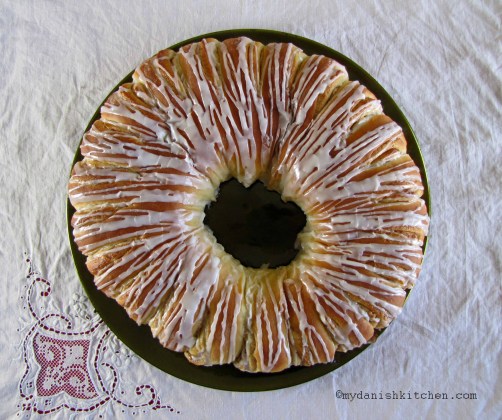
Vetekrans aka Swedish Tea Ring is a very delicious coffee cake. The cake is called a coffee cake but there is no coffee in it, it just means it’s served with coffee or tea. The dough is surprisingly light in texture and the cake is simply just amazing when served right out of the oven, which I would recommend.

This recipe uses the cold rise method. It tells you to let your dough rest in the refrigerator for 2 to 24 hours. I was pressed for time when I made this wonderful Tea Ring because my husband Joe was taking it with him to his Blacksmith meeting, so I could only let it rest in the fridge for 1 hour but it still turned out beautifully. The recipe makes a huge amount of dough which I thought was a bit much, so I cut off four 1 inch pieces of the rolled up dough and baked them separately as cinnamon rolls, yum! And as you can see there was still plenty for the Tea Ring to go around.

Word of advise: Just to simplify rolling out the dough, I marked off my work surface for how big the dough was supposed to be. I used four pieces of white sticker labels (you could also use small pieces of post-it-notes). Also, make sure the dough is rolled out as even as you can get it on your work surface. This will ensure your finished roll/ring will be the same thickness throughout. If you have a thicker area in your ring, baking can be a little uneven. 😉

This post will be submitted to YeastSpotting.

Ingredients:

For the dough:

4 1/2 teaspoons active dry yeast (or 50 grams cake/fresh yeast)

1 cup warm water (100-110 degrees F)

1/2 cup butter, melted

1/2 cup sugar

3 eggs, lightly beaten

1 teaspoon salt

1 teaspoon ground cardamom

4 to 4 1/2 cups all-purpose flour

vegetable oil, for greasing bowl

For the filling:

1/2 cup butter, softened

1/2 cup sugar

1 tablespoon ground cinnamon

For the glaze:

1 cup confectioners sugar

2 tablespoons milk

1/2 teaspoon almond extract

Directions:

Pour warm water (100-110 degrees F) into a bowl and sprinkle active dry yeast into water, let sit for 10 minutes. In the bowel of a stand mixer fitted with the dough hook, add the 1/2 cup melted butter, sugar, eggs, salt, cardamom and dissolved yeast/water. With the mixer on medium-low speed, add the flour in increments and mix until dough is smooth (you may not need all the flour). Lightly grease a large bowel with vegetable oil. Place dough into oiled bowel, cover with plastic wrap and refrigerate dough for 2-24 hours.

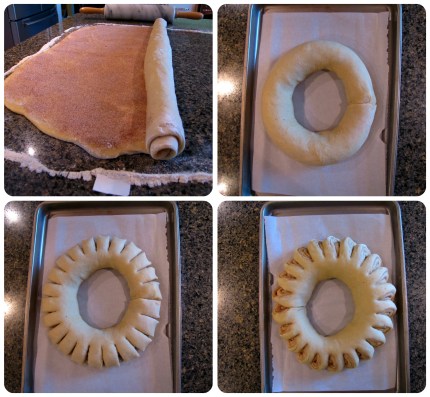
Fit a large baking sheet with parchment paper and set aside. Place dough onto a floured work surface and roll out to a 20 x 24 inch  diameter. Make sure dough is rolled out evenly without any high spots. Gently spread a thin layer of the softened butter all the way out to the edge of the dough. Mix sugar and cinnamon together and sprinkle over the butter. Starting from the long edge, roll dough tightly as a jelly roll. Move roll from work surface to baking sheet and shape into a ring. Gently press edges together to seal. With scissors, cut 2/3 way through the ring at 3/4 inch intervals. Twist each cut piece so the inside is visible. Cover ring with a dry, clean tea towel and let rise for 1 hour. Preheat oven to 375 degrees F. Bake for 15-20 minutes or until golden brown. Allow Tea ring to cool on baking sheet for 10 minutes. Mix glaze ingredients together and sprinkle on top of ring. Enjoy!

Source: The Great Scandinavian Baking Book

Print Friendly and PDF

Read Full Post »

Greek Tzatziki Sauce

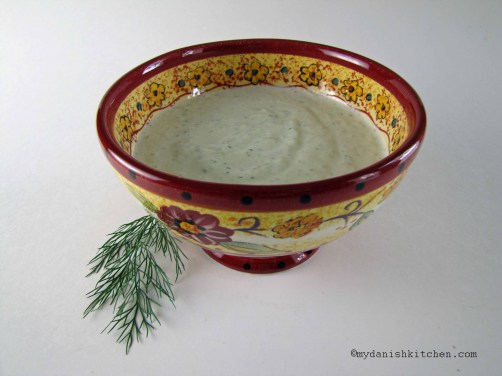
I have been eyeballing the Greek Tzatziki sauce for quite some time now. Does yogurt, cucumber, garlic and dill not sound perfectly delicious to you? or does it sound a bit foreign and odd? Well I assure you that it’s a wonderful creation! If you decide to make this sauce I would recommend that you make it one day before you intend to use it. Place it in the refrigerator overnight to really allow the flavors to develop. Also, make sure to use a plain Greek yogurt which has a thicker consistency. If you decide to use regular yogurt, you’ll need to let the liquid drain from the yogurt for 2 hours before using, to get the thicker consistency.

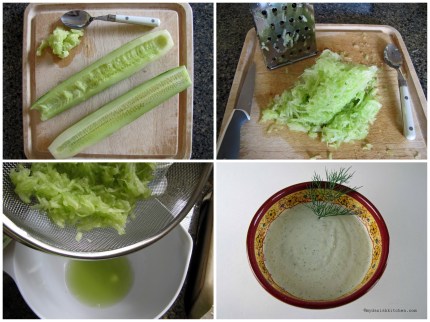
Making Tzatziki Sauce

Tzatziki sauce of course goes perfectly with the Greek Gyro sandwich. The first time I tasted a Gyro was actually in Denmark when I was a teenager and it left a big impression on me because it was super delicious….nothing like I had ever tasted before. Since then I’ve had Gyro’s from time to time, some better than others, and I finally decided to make the Tzatziki sauce myself. This recipe is truly wonderful, even my husband who does not eat yogurt or cucumber, really liked it – imagine that! Some other uses for the Tzatziki sauce could be served with Pita wedges as an appetizer, goes well with lamb, fish, chicken, veggies and falafel. I hope you enjoy this sauce as much as we have 🙂

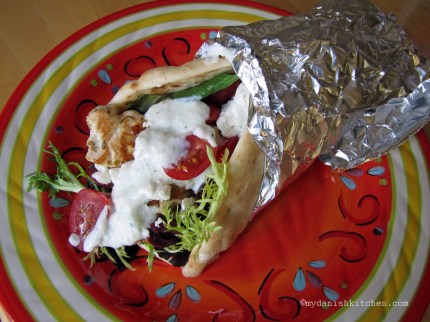
Greek Gyro

Ingredients:

Tzatziki Sauce:

1 english cucumber, seeded

1 teaspoon salt, to draw out liquid in cucumber

1 lb Greek yogurt, plain (1 1/2 cup or 450 grams)

1/2 lemon, juiced

1 garlic clove, minced

1/2 tablespoon dill, chopped

Salt and Pepper, to taste

Gyro:

chicken, cut into bite-size pieces and cooked to your liking

onion, slice and cook until soft and sweet

Pita bread

lettuce

tomatoes

kalamate olives

feta cheese

Tzatziki Sauce

Directions:

To make Tzatziki Sauce: Peel cucumber, cut in half lengthwise and scrape out seeds using a spoon. Chop or shred cucumber and sprinkle with 1 teaspoon salt to draw out the liquid. Place cucumber in a sieve to drain for at least 1/2 hour. In a small bowl combine yogurt, lemon juice, garlic and dill. Once the cucumber has finished draining, add it to the yogurt mixture and give it a quick spin in the blender until you have your desired consistency. Place in refrigerator for at least 3-4 hours before serving to allow flavors to develop, or even better, leave it refrigerated overnight.

To assemble Gyro: Wrap gyro in aluminum foil and heat in toaster oven for a few minutes until warm. Add the warm chicken and onions. Top with lettuce, tomatoes, olives, feta cheese and Tzatziki sauce. Wrap loosely in foil to hold Gyro together and enjoy!

Source: adapted from Kalyn’s Kitchen

Print Friendly and PDF

Read Full Post »

Brunsviger

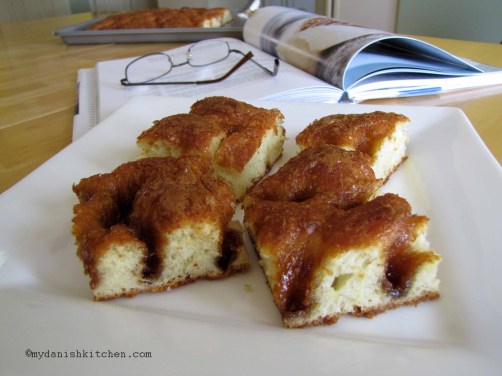
Brunsviger is a classic Danish coffee cake of sorts. It comes from Fyn (Funen) in Denmark, the island where Hans Christian Andersen was born. It is a soft yeast dough topped with a generous serving of butter and brown sugar. It’s traditionally served warm in the morning or with afternoon coffee or tea and it’s always best the same day it is made. If you have some left-over cake you can heat it up a little and it’s still delicious.

The challenge I had making this cake was that the pan size called for, was an odd size (16×20 inch) which I don’t have. So the first time I made this coffee cake I made it “free style” if you will, simply just forming it onto a baking sheet. But it resulted in a lot of the topping flowing off the cake and making a big mess in my oven. After a weeks time of pondering I gave it another shot and this time I decided to use my 9 x 13 inch pan which is not the “correct” size but it does have tall sides as oppose to the baking sheet, and I am happy to say that it worked out great. The topping stayed on top and really seeped into the cake. Make sure to make plenty of finger dimples in the cake because this is where the yummy stuff hangs out.  🙂

Brunsviger – 12 to 16 servings

Ingredients:

1 cup whole milk, warmed to 100-110 degrees F (37-43 degrees C)

4 1/2 teaspoons active dry yeast (or 50 grams cake/fresh yeast)

6 tablespoons butter, melted

2 eggs

2 tablespoon sugar

1/4 teaspoon salt

3 1/2 cups all-purpose flour

Topping:

3/4 cup packed dark brown sugar

1 cup butter

Directions:

Heat milk to to 100-110 degrees F (37-43 degrees C), sprinkle active dry yeast over milk, give a quick stir and let sit for 10 minutes. Meanwhile melt butter and set aside.

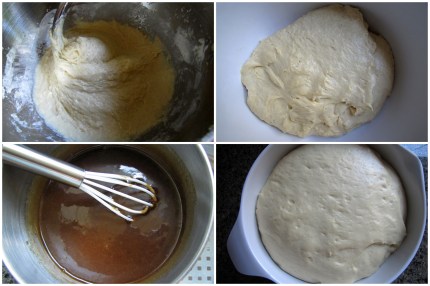
Pour milk mixture into the bowl of a stand-mixer. Add eggs, sugar, salt and melted butter, stir to combine. Using the dough hook start the mixer on medium-low speed and add the flour in small increments. Note: you may not need all the flour. Scrape down the sides of bowl with a rubber spatula as needed and continue to add the flour until dough is soft, elastic and slightly sticky. Grease a large bowl with a small amount of baking spray or vegetable oil, place dough in bowl, cover with a clean dry tea towel and let rise for 30 minutes.

Spray a 9 x 13 inch (23 x 33 cm) baking pan with baking spray and line with piece of parchment paper extending up to the edges of pan. Deflate the dough and pour into baking pan. If dough is a little too tacky cover your fingers in a light dusting of flour. Press dough evenly out into the corners of the baking pan. Cover pan with the tea towel and let rise for another 20 minutes.

Preheat oven to 400 degrees F (200 degrees C).

To make the Topping: Over low heat melt butter with the brown sugar. Stir frequently to ensure sugar is completely melted and butter in fully incorporated. Do not boil! Remove from heat and cool slightly.

Pour 2/3 of topping over dough and spread evenly. Press your fingers into the dough to make deep dimples. Pour the remaining 1/3 of topping over dough and bake for 25-30 minutes. Serve Brunsviger warm. Enjoy!

Source: adapted from The Scandinavian Cookbook

This recipe has been submitted to YeastSpotting, a wonderful site filled with recipes containing yeast.

Print Friendly and PDF

Read Full Post »

Hyldeblomst Saft

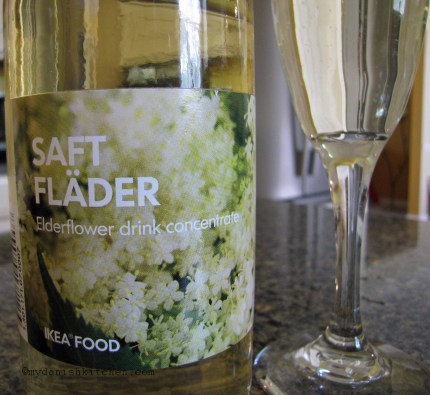
Hyldeblomster (Elderflowers) has played a big role in Nordic mythology. It was believed that the goddess Freja lived by the Elderflowers and that the bushes provided protection from evil. The flowers were also thought to give relief from ailments such as toothaches, fevers, depression and insomnia. In today’s modern Denmark Elderflowers are still very popular but for different reasons. Today the mature flowers are used to make a wonderful tasty juice concentrate. The Elderflower bushes can be found growing wild in the woods, fields or parks and the time to harvest the fragrant flowers is in early June. I have never come across Elderflowers here where we live, then again, I haven’t really gone scavenger hunting for them either. In any case, I did come across some delicious Elderflower concentrate at my all-time favorite store IKEA and wanted to share with you this refreshing drink which is perfect for the hot summer days here in Virginia.

Hyldeblomst Saft – Elderflower Concentrate

Ingredients:

Makes 1 glass

Hyldeblomst (Elderflower) with Water

1/4 cup Elderflower concentrate

3/4 cup ice-cold water

ice cubes

lemon slice

Hyldeblomst (Elderflower) with Carbonated Water (and Rum)

1/4 cup Elderflower concentrate

3/4 cup carbonated water (such as Perrier)

ice cubes

1 shot Captain Morgan’s Spiced Rum (optional)

Directions:

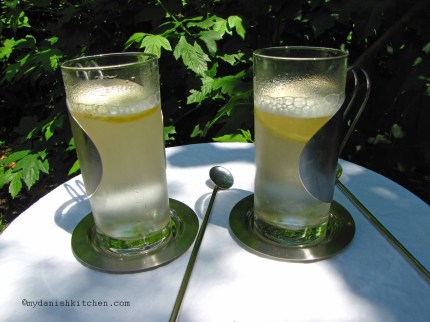
Making sure the water or carbonated water is ice-cold, mix with concentrate. Add ice cubes and remaining ingredients such as lemon slice and rum if desired. Enjoy!

Hyldeblomst Saft mixed in blender with ice.

Source: My Danish Kitchen

Print Friendly and PDF

Read Full Post »

Kammerjunker – Twice Baked Biscuits

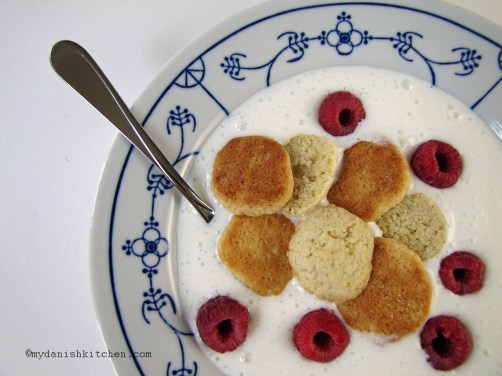
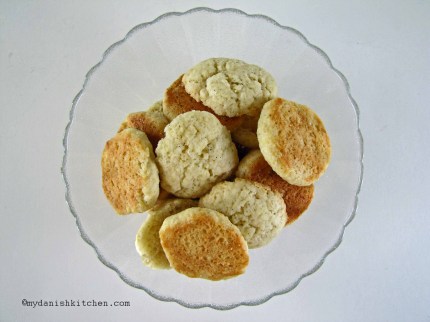
Kammerjunker is a small twice-baked biscuit which is served with the Danish summer dish Koldskål. I have been promising to write a post about Kammerjunker for quite some time now and with summer right around the corner I find myself day-dreaming about cold, sweet and tart delicious Koldskål with some crunchy homemade Kammerjunker. And so here they are!

Kammerjunker – Twice baked biscuits

I have to say that the home-made Kammerjunker completely beats the store-bought kind. These turned out crunchy and so tasty that I had to fight off my husband for them. Btw he told me to tell you that they are also great with a little jam and Nutella on them (shaking her head in disbelief). They are not overly sweet like the ones from the store, which I really like, besides I find the store-bought kind more like a cookie anyway. I hope you enjoy these as much as we have.

Kammerjunker – makes 48 whole or 96 half sliced biscuits

Ingredients:

250 grams all-purpose flour (8.8 oz.)

2 teaspoons baking powder

100 grams sugar (3.5 oz.)

1/2 vanilla bean

1/2 teaspoon cardamom

100 grams butter, room temperature (3.5 oz.)

1 egg

1/2 deciliter milk (1.7 oz.)

Directions:

Scrape the seeds from the vanilla bean and mix with a small amount of the sugar to separate the seeds. In a large bowl add flour, baking powder, sugar, seeds from vanilla bean and cardamom, stir to combine. Cut butter into pieces, add to flour mixture and using your clean hands work butter and flour together until crumbly. Add egg, mix only until incorporated. Add milk and mix only until dough comes together. Wrap dough in plastic wrap and place in refrigerator for 1 hour.

Preheat oven to 345 degrees F (175 degrees C). Line two large baking sheets with parchment paper and set aside.

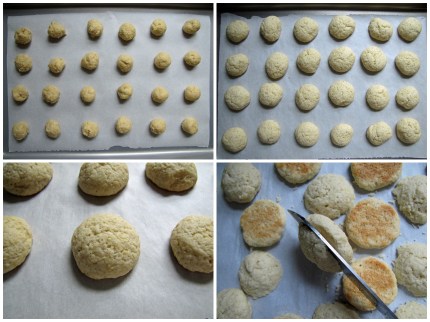
Roll small pieces of dough into approx. 2 centimeter (0.8 inch) balls and place on baking sheet 2 centimeter apart. Bake for max 10 minutes. Remove from oven and while biscuits are still warm slice into halves using a serrated knife. Place back onto baking sheet with cut-side down.

Lower heat in oven to 200 degrees F (100 degrees C) and continue to bake for another 45 minutes to dry biscuits out. Allow to cool completely before storing Kammerjunker in a cookie tin. Enjoy!

Source: adapted from Det Søde Liv

Print Friendly and PDF

Read Full Post »

Danish Birkes

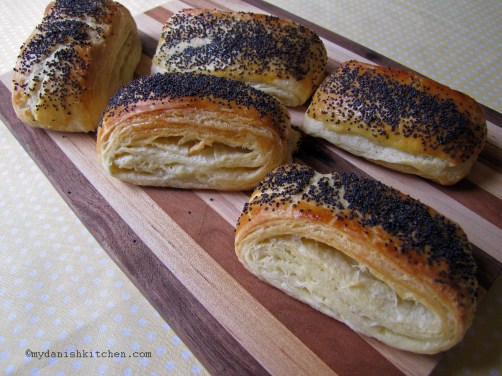
Up until the time I decided to make Birkes, I thought there was just one type of Birkes. But that is not the case at all. When I started researching recipes I discovered three different kinds of this super delicious Danish pastry.

I was born and raised in a part of Denmark called Jylland where the pastry is referred to as Birkes or Thebirkes. This Birkes does not have a Remonce filling and the pasty at our house was always sliced in half and topped with jam or cheese…super delicious! My search lead me further east to Sjælland which is the island where Copenhagen (København) is located. Here the pastry is called Københavnerbirkes or Thebirkes and the wonderful people in the Copenhagen area makes the pastry with a Remonce filling…equally wonderful in its own way. Grovbirkes, as far as I can tell, can be found throughout Denmark and it is made with a healthy portion of flaxseed, sesame seeds and/or sunflower seeds…this one I have never tasted.

My favorite is the Birkes without Remonce, I guess because it’s the one I grew up with. The Birkes is flaky and buttery in the best true Danish style. The Københavnerbirkes is sweeter in taste, and as far as I can tell, the pastry is eaten as-is. There is a lot of conversation going on out there in Cyber-land about Birkes vs Københavnerbirkes and I was surprised to find out that people from one end of the country to the other, is not really aware of the other kind of Birkes. When I called my parents to ask them about Birkes with a Remonce filling my mother said that she had never heard of “such a thing”, so apparently I am not the only one 🙂

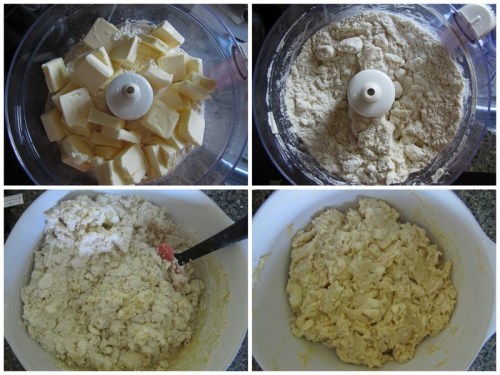
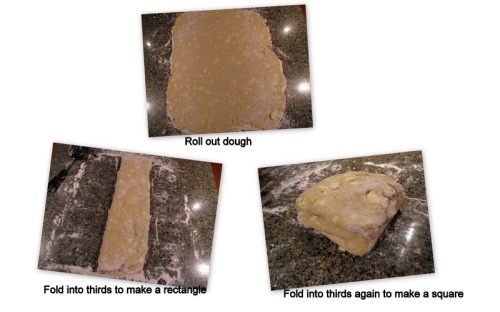
Notice the clumps of butter in the two pictures on the right. The butter should be the size of kidney beans.

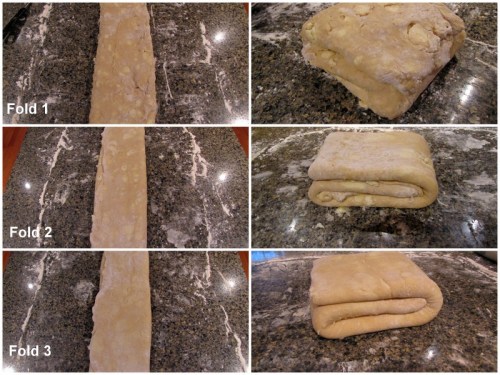
Rolling and folding process.

The dough is rolled out, then folded into thirds and folded into thirds again.
This process in repeated three times. Notice how you still see the butter in the dough.

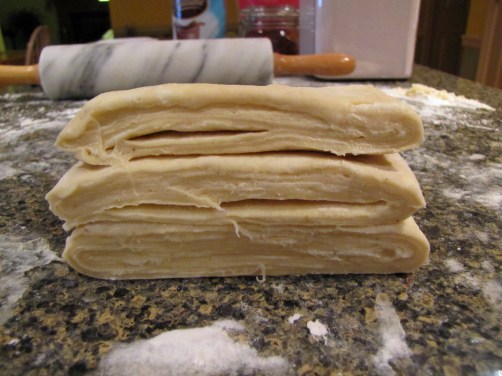
Puff pastry (Butterdej) with all its wonderful layers!

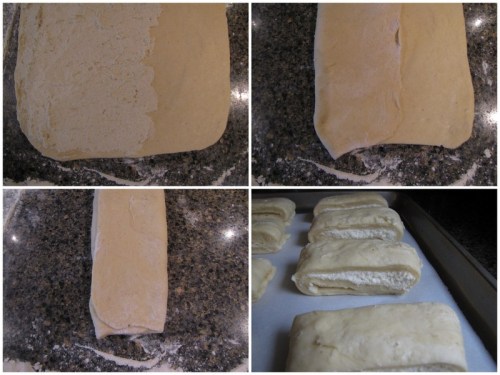
If making Birkes with Remonce, spread remonce over 2/3 of dough, fold into thirds and cut into 2 inch rectangles.

Note: after I filled with Remonce, I placed the dough on the baking sheet upside down so the filling was towards the top. I think this may have resulted in the Birkes that had the filling in them, turned out like The Leaning Tower of Pisa. So try to place them on the baking sheet with the filling towards the bottom.

Makes 2 portions of Puff Pastry dough (Butterdej).

Ingredients:

For the dough:

3 1/2 cups flour (15 3/4 oz) (450 grams)

1 1/2 cups cold unsalted butter (12 oz) (340 grams)

4 1/2 teaspoons active dry yeast (or 50 grams cake/fresh yeast)

1/2 cup warm water (4 oz) (118 ml) (100 – 110 degrees Fahrenheit)

1/2 cup heavy cream (4 oz) (118 ml)

1/2 teaspoon cardamom

1/2 teaspoon salt

2 eggs, room temperature

1/4 cup sugar (1 3/4 oz) (55 grams)

For Remonce filling: optional

2.8 oz butter (80 grams) at room temperature

2.8 oz sugar (80 grams)

2.8 oz marzipan (80 grams) at room temperature

For final assembly:

1 egg, slightly beaten for brushing

Poppy Seeds for sprinkling

Directions:

Place flour into bowl of food processor with steel blade. Cut cold butter into 1/4 inch slices and add to flour. Pulse flour and butter until the butter is the size of kidney beans.

In a large bowl, dissolve the yeast in the warm water. Let stand 10 minutes. Stir in the cream, cardamom, salt, eggs and sugar and mix until combined using a fork. Using a rubber spatula, turn the flour/butter mixture into the liquid and carefully mix just until the dry ingredients are moistened. Cover and refrigerate for 4 hours, overnight or up to 4 days.

Turn the dough out onto a lightly floured surface, dust top of dough with flour. Roll out dough to make a 16 to 20 inch rectangle. Fold dough into thirds, rotate dough a quarter of turn and fold into thirds again, making a small square. Turn over dough. Repeat rolling and folding another two times (making it a total 3 times of rolling and folding), ending with a small square. Using a sharp knife cut dough into two halves. Wrap each 1/2 portion of dough in plastic wrap, place both dough portions in a plastic bag and chill for at least 30 minutes.

Refrigerated dough is now divided into 2 halves. Each half of dough will make 10 birkes rolls. If you are not using the second half of dough, it can be frozen for later use. Defrost in refrigerator for 24 plus hours before using.

If using the Remonce filling, make it at this time. Use a hand-held mixer, beat the butter, sugar and marzipan to a smooth soft spreadable cream. Set aside.

Remove first half of dough from refrigerator and place on a lightly floured surface, dust top of dough with flour. Roll dough out to a 12 x 18 inch rectangle. If using Remonce filling, spread a thin layer of the filling over 2/3 of the long edge of dough. Starting with the long edge that has the filling, fold 1/3 of dough over the middle. Then fold the remaining 1/3 of dough without filling over the middle, the dough is now folded into 3 layers. Using a sharp knife, cut dough into approximately 2 inch rectangular pieces. Place pieces of dough onto a baking sheet lined with parchment paper. Allow to rise for 20-30 minutes.

Preheat oven to 350 degrees F (180 degrees C). Lightly beat egg and brush onto top of dough. Sprinkle with poppy seeds. Bake for 15-20 minutes or until golden brown. Allow Birkes to cool on baking sheet. Birkes with Remonce filling is eaten as is. Birkes without filling is sliced in half and topped with jam or cheese. Enjoy

Source: My Danish Kitchen

This recipe will be submitted to YeastSpotting.

Print Friendly and PDF

Read Full Post »

Bruschetta

Bruschetta is so simple to make, I almost feel a little silly for blogging about it….almost. But with all this warm and sunny Spring weather we have had this year here in Virginia ,I feel inspired to share my Bruschetta with you. It’s a small morsel loaded with flavor. Between the juicy fresh tomatoes, fragrant basil, crunchy bell pepper and wonderful garlic it’s almost flavor overload. I would like to recommend using a flavorful aged Balsamic Vinegar because it really makes a big difference in the outcome. Enjoy!

Ingredients:

Bread – French Baguette, toasted

Tomatoes

Red Onion

Yellow Bell Pepper

1 Garlic Clove (1/2 minced, 1/2 for rubbing bread)

Basil leaves

Salt to taste

Balsamic Vinegar

Extra Virgin Olive Oil

Parmigiano Reggiano – shredded

Directions:

Remove seeds from tomatoes. Dice tomatoes, onion, bell pepper, 1/2 of garlic clove, place into small bowl. Chop basil leaves and add to tomatoes. Season with salt to taste. Add a small amount of Balsamic Vinegar. Toss together and drain off some of excess liquids. Set aside.

Slice french bread and toast. While toast is still hot, rub toast with the remaining 1/2 garlic clove. Top toast with tomatoes, drizzle with a little more Balsamic Vinegar, olive oil and top with shredded Parmigiano Reggiano. Serve immediately. Enjoy!

Source: My Danish Kitchen

Print

Read Full Post »

« Newer Posts - Older Posts »