Feeds:
Posts
Comments

Posts Tagged ‘Danish’

Kanelsnegle

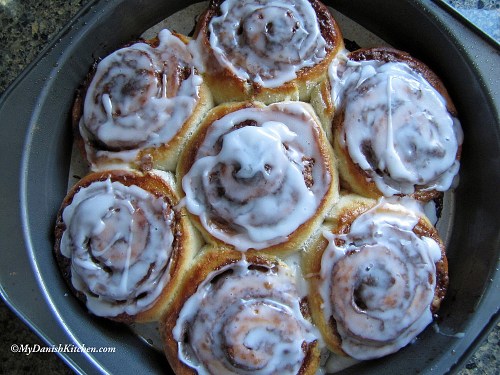
I made my first Kanelsnegle (Cinnamon Buns) in Home-Ed class. Does any high schools offer Home Education classes anymore? The class gave me a basic knowledge of cooking and baking. It sparked an interest for baking in particular and I baked quite a bit when I was a teenager. This is still something that I truly enjoy. By the way, I also took woodworking, but no sparks came from that class ha ha 🙂

Rolling up dough

Kanelsnegle ready for baking

Just a note about yeast. In Europe the preferred type of yeast is Fresh Active Yeast as compared to the American preference of Dry Active Yeast. Fresh yeast (also called Cake yeast or Bakers compressed yeast) can sometimes be found in the dairy section of certain grocery stores. It has a short expiration date and so it’s very perishable but works faster and longer. Fresh yeast is dissolved in liquid 70-80 degrees F. Store it in the refrigerator or freeze for up to 4 months. Dry yeast on the other hand has a much longer expiration date and is more forgiving of mishandling. To activate it sprinkle on water that’s between 100-110 degrees F and wait to see small bubble (about 10 minutes). Note if your liquid is too warm you’ll kill the yeast and adding a teaspoon of sugar to the liquid will provide a little food for the yeast, encouraging it to “wake up”. Typically, 50 grams of Fresh yeast = 4 teaspoons Dry yeast (12 grams).
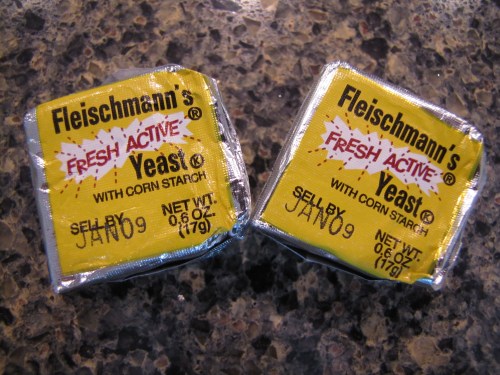
Fresh active yeast

Ingredients:

25 grams Fleischmann’s Fresh Active Yeast

2 1/2 deciliter milk (1 cup)

2 tablespoons vegetable oil

1 tablespoon sugar

1 teaspoon salt

1 teaspoon cardamom

400 grams flour (3 1/2 cups)

small amount of oil for the bowl

plus 1 egg for brushing cinnamon buns

Filling:

75 grams butter at room temperature (5 tablespoons)

75 grams sugar (1/2 cup)

2 tablespoons cinnamon

50 grams marzipan (about 1/4 cup) (optional)

Glaze:

1 cup confectioners sugar

1-2 tablespoons hot water

Directions:

Dissolve yeast in cold milk stirring gently. Add oil, sugar, salt and cardamom. Add flour a little at the time and knead until you have a firm dough. Place a small amount of oil in the bowl and turn the dough in the bowl. Cover bowl with plastic wrap and let dough rise to double in size (30-60 minutes).

Place room temperature butter, sugar and cinnamon in a small bowl. If you’re using marzipan, break it up into small pieces and mix into butter using a fork to help break it up a little.

Prepare two round 8 inch baking pans by placing a round piece of parchment paper in bottom of pan and spray with non-stick oil. Or you can place parchment paper on a baking sheet.

Sprinkle tabletop with flour and roll out dough to 40 x 50 centimeter (15 x 19 inches). Spread butter filling onto dough and roll into a log starting at the long edge. Cut dough into 14 even slices. If using round baking pans, place cinnamon slices in a circular fashion – 7 slices in each pan. If you using a baking sheet, place cinnamon slices right next to one another. By placing slices close to one another during baking is keeps the finished cinnamon buns moister. Cover baking pans or baking sheet with a dry kitchen towel, place in a warm location and allow to rise for another 30 minutes.

Preheat oven to 225 degrees Celsius (about 425 degrees Fahrenheit). Bake for 12 to 15 minutes. Let cool for 5-10 minutes before glazing. To make glaze, simply combine confectioners sugar and water until desired consistency. Enjoy!
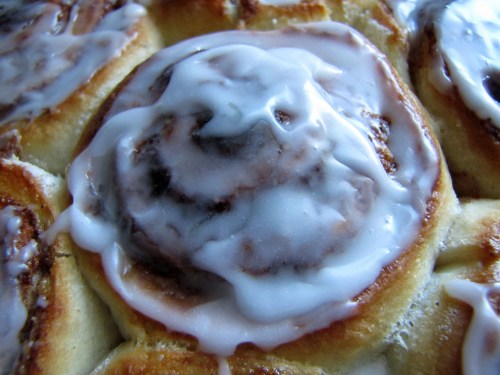
Kanelsnegl

Source: Signes Mad

Print

Read Full Post »
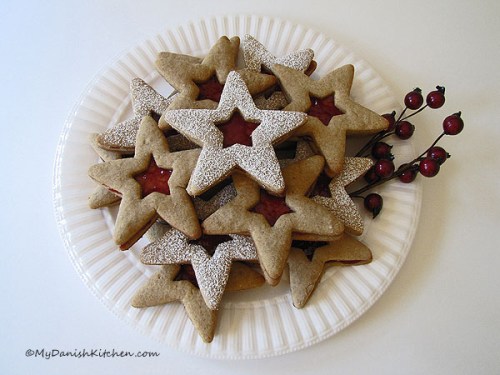
Marmorkage

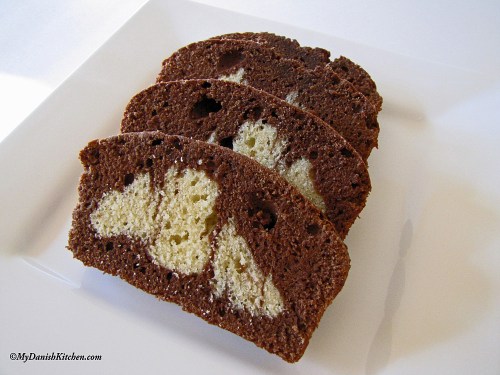
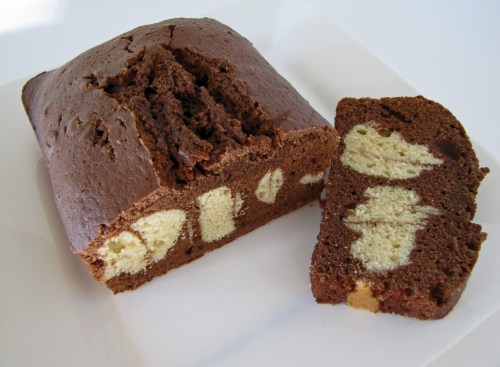
This cake was the very first cake I learned to bake and I made it quite often when I was a young girl. It was my favorite cake at that time. It had been years since I last baked this cake that I had almost forgotten about it. Then when I played the blogging game “Tag” I was reminded of it and I decided it was time for a revisit. This version of Marmorkage is a dense cake which is not overly sweet. The original version has more white cake than chocolate, but since I love chocolate I always reverse it.

Marmorkage

Ingredients:

130 gram salted butter (1 stick plus 1 tablespoon)

200 gram sugar (1 cup)

3 eggs

1 teaspoon baking powder

250 gram flour (2 1/4 cup)

1 deciliter milk (1/2 cup plus 2 tablespoon)

6 tablespoon cocoa

Directions:

Preheat oven to 170 degrees Celcious (340 degrees Fahrenheit). Coat loaf pan with butter and dust with flour, shake out excess flour and set aside.

Place butter in small saucepan and melt over low heat. Once melted, place in a mixing bowl, add sugar and mix well. Add eggs one at a time and mix well. Stir flour and baking powder together. Add flour and milk in small increments until incorporated. Remove 1/3 of dough to a small separate bowl, this will remain the white colored dough. To the remaining 2/3 dough, add cocoa and stir until well blended.

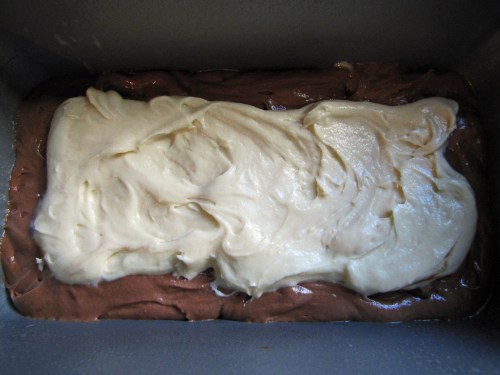
Place 1/2 of cocoa dough in bottom of loaf pan, add white dough, then add the remaining cocoa dough as the top layer. Take a fork and run it up and down the dough layers a couple of times to create a marbeling effect. Bake in preheated oven for 1 hour 15 minutes or until a toothpick comes out clean. Enjoy.

Chocolate and white dough, top off with chocolate dough.

Source: My Danish Kitchen

Print

Read Full Post »

Ris a la Mande

Risalamande

During the 1800’s the citizen’s of Copenhagen felt the need to separate themselves from the farming community and this also affected our Christmas food. They added whipped cream and almonds to our beloved Danish Risengrød and called it Risalamande to give it some French flair, because that is what was in fashion at that time. Kristeligt Dagblad

Danish Christmas Tradition: Mandelgaven (the Almond Present)

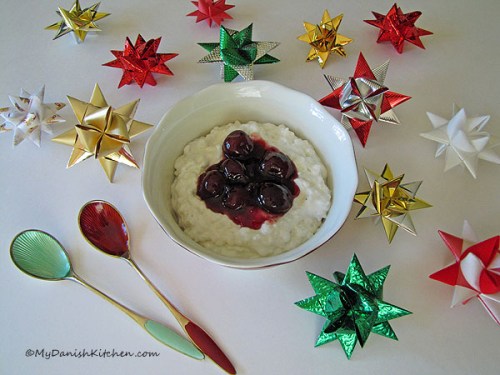
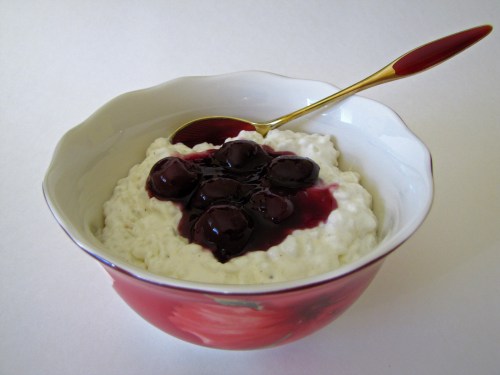
Today you still see Ris a la mande served in most Danish households on Christmas Eve. Since then, we have add a warm Cherry Sauce to top it off and traditionally a fun game goes along with eating this wonderful Christmas treat. A single whole Almond is blanched and stirred into the Risalamande to hide it. The dish is served after Christmas dinner and whoever finds the almond wins a gift. The problem with the Almond gift is that the winner could be anyone from a child to grandmother. This is often solved by giving a traditional small Marzipan pig as the gift, but today, the gift could be anything. Also, there is a lot of cheating going on with this game. Some may choose to place an Almond in each of the children’s bowls so all the children gets a gift. I think my Mom did that one year but we thought the game should be done “the right way”. I can honestly say that I have never won this game. The winner in our home was typically my Dad. He would often times get the almond and then he would keep it hidden against his cheek until all the Risalamande was eaten up. Sneaky.  One year my Dad took pity on me and gave me the Almond under the table 🙂 but I didn’t feel right taking the gift since I did not honestly win it.

I should also mention that some households may chop blanched Almonds into small pieces and add them to the dish. We have never done this at our house, instead pure Almond Extract is added giving the dish a wonderful Almond flavor. This dish is by far one of the biggest highlights of Christmas for me and I continue to serve it every single year, for it would not be Christmas without it.

Risalamande with warm Cherry sauce

Update:

I am very honored to be asked to participate in the LexioPhiles International Recipe Advent Calendar 2011. My recipe for Risalamande with warm Cherry sauce will appear on December 2nd, 2011.  LexioPhiles will feature a new recipe every day during the month of December from bloggers around the world.

Ingredients for 1st stage – Risengrød:

1 1/4 cup water

1 cup rice (Grødris)

4 1/2 cup milk

1 teaspoon vanilla sugar

Ingredients for 2nd stage – Risalamande:

1 1/2 cup whipping cream

3 tablespoon confectioners sugar

4 teaspoon pure almond extract

2 whole almonds

For the Cherry Sauce:

15 oz can Oregon Bing Cherries in heavy syrup

1 tablespoon cornstarch

water

Directions:

Place water and rice in a medium cooking pot, cover with a lid and simmer for 2 minutes. Add milk and vanilla sugar and simmer covered over low heat for 40-45 minutes. Stir often to make sure the milk does not burn, especially the last 30 minutes. You may have to turn the heat all the way down as low as your stove will allow for the last 15 minutes.

Place in Tupperware and refrigerate for several hours or overnight.

Once mixture is completely cooled remove from refrigerator and break it up with a spoon. In a small bowl add whipping cream, confectioners sugar and almond extract. Beat with a handheld mixer until you see tracks from beaters in the cream. Add half of the whipping cream to rice mixture and combine well with a spoon, add remaining whipping cream in small increments. The final  texture should be creamy and easily mixed with the spoon. Place covered in refrigerator until ready to serve.

To blanch almonds. Place almonds in a small dish and pour boiling water over to cover. Let sit in water for 1 minute, drain and rinse with cold water. Pat dry and slip the skins off. I usually blanch two almonds in case I have trouble with one. Before serving Risalamande, place one blanched almond in mixture and stir well to hide almond.

In a small dish mix together the cornstarch and some water to form the thickening agent. In a small saucepan bring cherry and syrup to a simmer. Add the cornstarch/water mixture to cherries a little at the time, stirring until syrup starts to thicken. Simmer for 1 minute and remove from heat.

Serve Risalamande cold with the warm cherry sauce on top.

Glædelig Jul and Merry Christmas♥

Source: My Danish Kitchen

Print

Read Full Post »

Risengrød

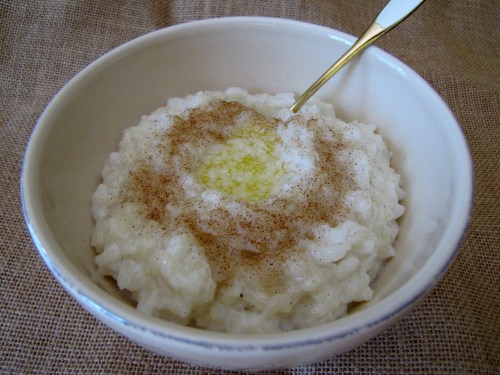
Risengrød

Danish Christmas Tradition: Nissen (a mythical creature of Scandinavian Folklore)

The Danish Nisse is a fictional character which has its roots from the 1800’s farming community. Nissen would help with the successful drift of the farm, that is, if you were respectful of the nisse and if you behaved yourself. A special dish which were served for Christmas is Risengrød. It may not seem special by todays measure, but back then milk, rice, butter, sugar and cinnamon was a commodity. And so, it makes sense that Nissen would be part of a festive event like Christmas.

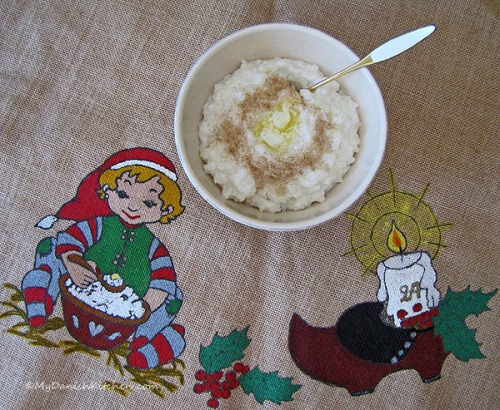
Today, the Nisse folklore is still alive and well, but in a different way. Songs have been written about the Nissen and he’s often seen in Children’s Christmas calendars whether it be on TV or on paper. He is an important part of decorating for Christmas in Denmark and Risengrød is still his favorite meal. In the picture above, which is part of my Christmas Tree skirt, you can see the Nissen getting ready to eat his Risengrød.

Risengrød

Ingredients:

1 1/4 cup water

1 cup rice (Grødris)

4 1/2 cup milk

1/2 teaspoon salt

1 teaspoon vanilla sugar

butter

sugar

cinnamon

Directions:

Place water and rice in a medium cooking pot, cover with a lid and simmer for 2 minutes. Add milk, salt and vanilla sugar and simmer covered over low heat for 40-45 minutes. Stir often to make sure the milk does not burn, especially the last 30 minutes. You may have to turn the heat all the way down as low as your stove will allow for the last 15 minutes.

Mix sugar and cinnamon together according to your taste. Serve the Risengrød warm, sprinkled with sugar/cinnamon mixture and place a dollop of butter in the center, letting the butter melt.

Glædelig Jul and Merry Christmas♥

Source: My Danish Kitchen

Print

Read Full Post »

Red Wine Gløgg

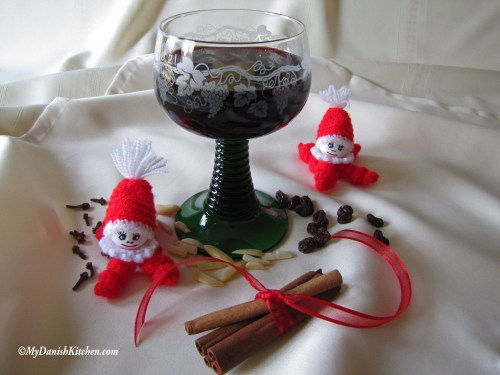
In the weeks leading up to Christmas there are many “get togethers” at work, in town, schools, clubs, friends and family stopping by to say hello. You can serve just about anything for your guests, really, or you could serve the traditional warm drink Gløgg and some warm Danish Æbleskiver. This combination is especially wonderful when you are coming in from the freezing cold outside.

Gløgg was imported to Denmark from our neighbors in Sweden and it started to take hold on the Danes in the years around WWII. There are many variations of Gløgg recipes out there and no one correct way to make it. Some contain brandy, cognac, port wine, vodka or snaps but the base is almost always red wine, although there are also some white wine versions, as well as non-alcoholic children’s versions. Back in the old days it was also thought to have some healing effects for winter depression, well at least for a short while 😉

Ingredients:

1 bottle red wine

1 cup white port wine

1 tablespoon Cardamom pods

1 stick Cinnamon

8 whole Cloves

4 pieces crystalized ginger

1 1/2 deciliter dark brown sugar (1/2 cup)

1 cup raisins

slivered almonds

Directions:

Place the cardamom pods, cinnamon stick, cloves, crystalized ginger and sugar in the port and red wine overnight or at least 1-2 hours before serving. Before serving, gently heat the liquid on the stove but do not allow to boil. Run the wine through a sieve to remove the spices, then add the raisins and almonds to the wine and serve warm.

Glædelig Jul and Merry Christmas ♥

Source: My Danish Kitchen

Print

Read Full Post »

Danish Æbleskiver

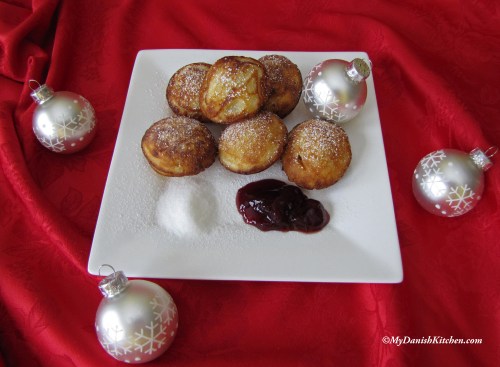
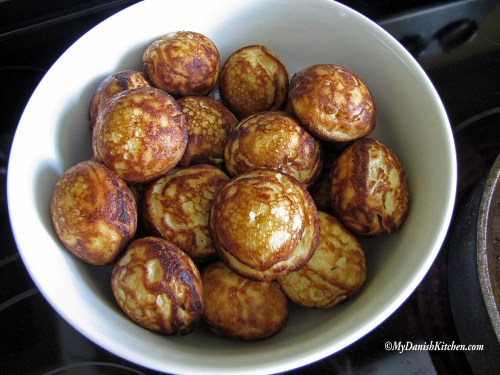
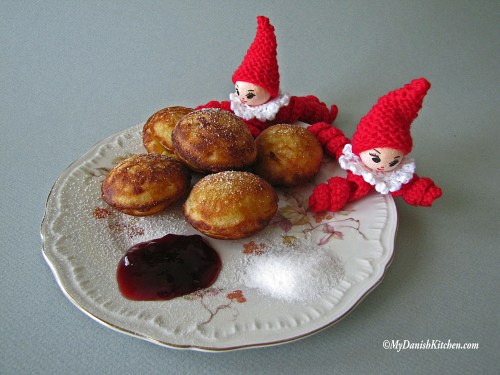
Æbleskiver is a tasty Danish dessert that looks like round puffy pancakes. The word æbleskive means apple slice and it first appeared in the middle ages where slices of apple were dipped in a batter and fried. When the æbleskive pan was introduce sometime in the 1700’s, æbleskiver were baked with small pieces of apple or prunes in the center. Today in Denmark æbleskiver is typically baked without anything in the center and they are served with a strawberry, lingonberry or raspberry jam or simply just dipped in sugar.

Æbleskiver are often served during the Christmas month perhaps as a special treat at a Christmas fair, when family or friends are visiting, little Christmas Eve (Dec 23rd) or maybe New Years Day. These Danish delicacies are served warm with a dusting of powdered sugar and sometimes with a warm glass of either red or white Gløgg.

Æbleskiver

Æbleskiver (makes 35)

Ingredients:

60 gram butter (4 tablespoon) – melted and set aside

250 gram flour (2 cups)

1 teaspoon baking powder

3 large eggs

4 tablespoon sugar

1/2 teaspoon Cardamom

1 cup whipping cream

1 cup buttermilk

a pinch of salt

zest of 1 lemon

Directions:

Melt butter and set aside. Sift flour and baking powder in a bowl. In a second bowl, beat eggs, sugar and cardamom until frothy and lighter in color. In a third bowl, stir together the buttermilk and cream. Taking turns, add flour and buttermilk to egg mixture while beating, mix until smooth. Add salt, lemon zest and cooled butter, stir to mix. Place batter in refrigerator and let rest 30 minutes. If batter is very thick after resting add a little more buttermilk. Use Canola oil or butter for frying.

Tips:

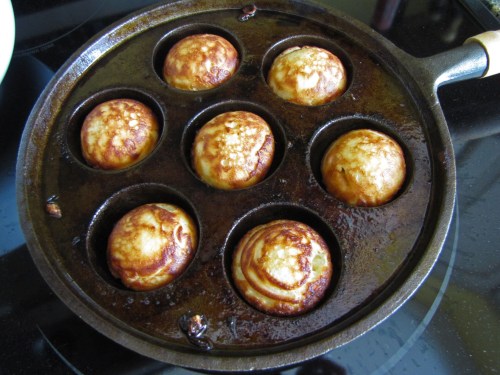
Must have a Æbleskive pan for cooking, making sure it is well seasoned if cast iron.

Traditionally, æbleskiver are turned with a thin knitting needle (why a knitting needle ? not sure, but you can find a knitting needle in most Danish households and the metal needle works really well grabbing the æbleskive to rotate in a cast iron pan). If you don’t have a knitting needle, try using a metal skewer or it can be done with a fork although a bit clumsy.

Make sure your heat is high enough, medium heat.

Make sure to preheat your pan, 5 to 10 minutes.

Use enough oil or butter for frying.

Some source recommend turning the æbleskiver in 1/3 turns or 1/4 turns while others turn them in 1/2 turns. Try the different methods and see what you feel most comfortable with. Here is a link with a video on how to make and turn the æbleskiver.

If you’re having trouble with the æbleskiver turning out right, don’t worry, the first pan-full rarely turn out perfect, keep going.

Æbleskiver can be refrigerated for up to 3 days or frozen for up to 4 months.

Glædelig Jul and Merry Christmas♥

Æbleskiver pan

Æbleskiver

Source: My Danish Kitchen

Print

Read Full Post »

Vaniljekranse

Vaniljekranse

Vaniljekranse is a traditional Danish cookie made in the weeks leading up to Christmas.  I have very fond memories of helping my Mom and Dad make vaniljekranse when I was a little girl. It’s a fun process of the dough coming out of the grinder into strips, cutting the strips into pieces and forming them into circles. The cookies have a sweet vanilla flavor and are slightly crunchy on the outside. Making Vaniljekranse makes for wonderful Danish family “hygge” (coziness).

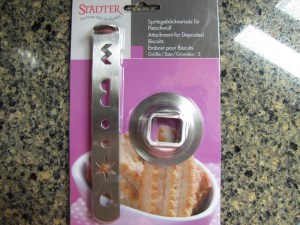
Vaniljekranse are not difficult to make, however, it took some doing to actually make it happen. The reason being, that in Denmark there is an attachment to your meat grinder that has a star shape on it. So the dough is run through the meat grinder with the star attachment. I could probably just have used a pastry bag with a star tip, I tried it, but it takes a lot of muscle to get the dough out. The other option would be to use a cookie press and you can get some sort of circle pattern, but I really wanted to show the making of this cookie the authentic way.

Vaniljekranse

Vaniljekranse

So I described the attachment to my wonderful husband Joe, he looked at the thickness of the meat grinder discs, and him being a Blacksmith and all, he was able to fabricate the disc for me…Yeah! My wonderful husband is so brilliant, I think I’ll keep him  🙂  He helped me make this cookie the authentic way. Thanks Joe.

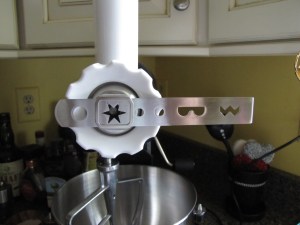
Update: I have since then been able to buy a star attachment in Bilka in Denmark while we were home for a visit, it fits my KitchenAid mixer perfectly.

Star attachment for KitchenAid

Star attachment for KitchenAid

Star attachment for KitchenAid

Star attachment for KitchenAid

Vaniljekranse

Ingredients:

375 grams flour (13 oz)

125 grams cornstarch (4.4 oz)

375 grams salted butter (13 oz)

100 grams slivered almonds (3.5 oz)

250 grams sugar (8.8 oz)

1 vanilla bean

2 teaspoon vanilla powder

1 egg

Directions:

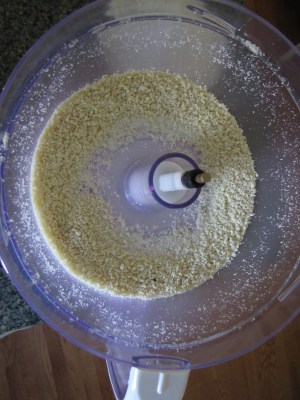
Place slivered almonds in food processor and blend until a powder. Set aside.

In a large bowl add flour and cornstarch, blend together. Cut butter into small pieces, add butter to flour mixture and blend together on low-speed with a handheld mixer until it starts to become crumbly. Cut open vanilla bean and scrape out seeds. Add vanilla seeds, vanilla powder, almonds and sugar, blend to combine. Add egg and mix to combine. Using your hands, press mixture together until it forms a dough. Wrap in plastic wrap and refrigerate for 1 hour.

Preheat oven to 390 degrees F (200 degrees C). Line baking sheets with parchment paper.

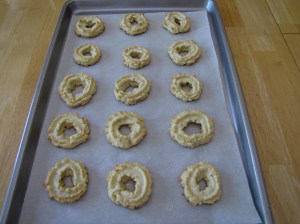
Using the star attachment for your meat grinder, pastry bag or cookie press to form your cookies. Traditionally, you will use a star attachment for your meat grinder. Cut dough into small segments and load into the meat grinder. Run the dough through the star attachment into long strips, place dough onto floured surface. Then cut dough into 4 inch long pieces and form into circle. Place on prepared baking sheets.  Bake in the middle of oven for 8 minutes or until slightly golden. Cool on baking sheets.

Glædelig Jul and Merry Christmas♥

Ground up slivered almonds

Dough coming out of grinder

Strips of dough

Vaniljekranse

Source: adapted from my Mother’s recipe

Print

Read Full Post »

Coconut Macaroon

Coconut Macaroon

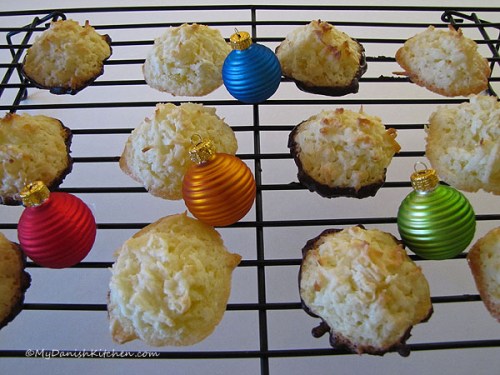
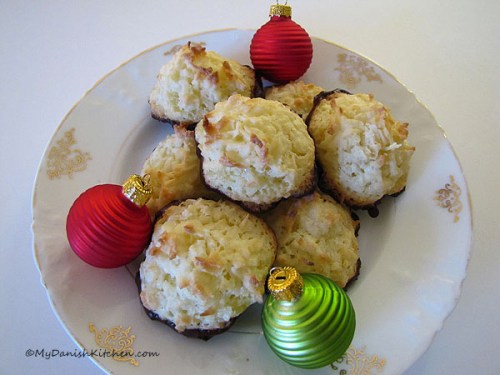
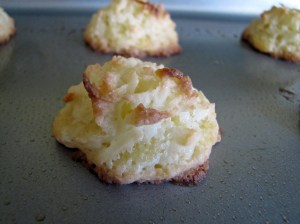
Coconut Macaroons are one of Joe’s absolute favorite cookies and I am right there with him. They are simply delicious! Crisp on the outside, soft and chewy on the inside and they could not be any easier to make. If you like, you can dip the bottom of the cookies in melted chocolate. I do half and half since Joe likes the addition of the chocolate, I however, thinks it takes away from the coconut flavor. Coconut Macaroons do not belong exclusively to Christmas time but they are likely to show up in our house anytime of the year. If you enjoy coconut then I’m sure you’ll love these wonderful little treats.

Coconut Macaroon

Coconut Macaroon

Danish Christmas Tradition: Kalenderlyset (Calendar Candle) and Juledekorationer (Christmas Center Pieces)

In addition to the Advent Reef, in Denmark we also have Calendar Candles which play in important role in the days leading up to Christmas. This tradition became popular under the German occupation in 1942 when Denmark was blanketed in darkness. The candle has the numbers 1 thru 24 printed on it and you light it every day just long enough to burn down one number. Once the candle is burned down to the 24th, it’s Christmas. Back home in Denmark, we would light our calendar candle at the breakfast table and one of us kids got to blow out the candle before it burned down too far.

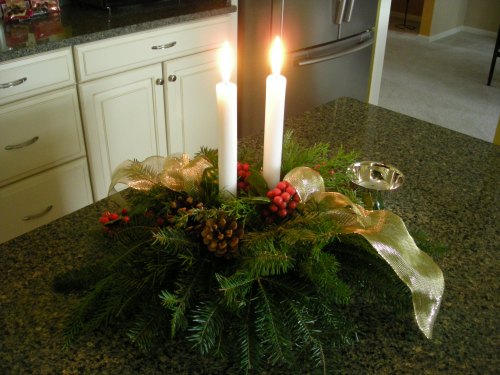
In Denmark it is also tradition to either buy or make Juledekorationer which are centerpieces with one or multiple candles. My parents always made our own and my Dad really got carried away with this task. We would typically end up with three or four beautiful juledekorationer placed at different locations throughout the house. When making the juledekorationer you can pretty much let your imagination run wild. You can use items like pine cones, cinnamon sticks, small christmas bulbs, bows and fresh greens (pine, holly etc). The juledekoration with its candles bring a calming, beautiful focal point into the room and a sense of that all important Danish “Hygge” (coziness) is created.

This juledecoration was given to me by my Danish friend Kaja

Coconut Macaroons

Ingredients:

2 large eggs

1 cup granulated sugar

1/8 teaspoon salt

1/3 cup all-purpose flour

1 teaspoon vanilla extract

3 cups (9 ounces) sweetened shredded coconut

Direction:

Position a rack in the center of the oven and preheat the oven to 350 degrees F. Grease an insulated baking sheet (or use 2 baking sheets stacked on top of one another).

In a medium bowl, whisk together the eggs, sugar, salt, flour and vanilla extract until well blended. Stir in coconut.

Using a 1-tablespoon measuring spoon,  drop the dough into mounds on prepared sheet, spacing them at least 2 inches apart. Bake the cookies for 14-16 minutes, until they are golden brown around the edges and a few strands of coconut on the tops of the cookie start to turn golden. Cool the cookies completely on the baking sheet on a wire rack. Repeat with the remaining dough.

Once the cookies are cooled completely, you can dip the bottom of the cookie in melted chocolate, if you desire.

Store in an airtight container at room temperature for up to 2 days. Cookies are best on the day they are made.

Glædelig Jul and Merry Christmas♥

Piled like a haystack

Right out of the oven Coconut Macaroon

Source: The Good Cookie by Tish Boyle

Print

Read Full Post »

Danish Pebernødder

Danish Pebernødder

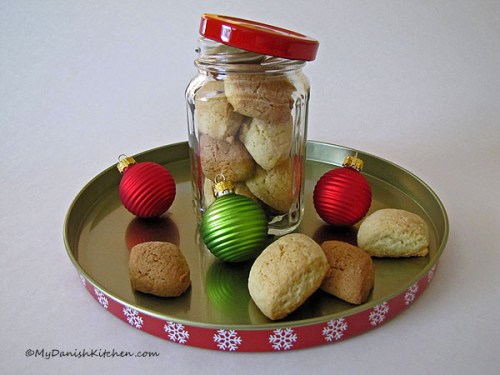
Pebernødder is a natural part of Christmas in Denmark and there is almost always a small bowl of Pebernødder accompanying the afternoon or evening coffee/tea time. Pebernødder may also be found in decorative paper cones (kræmmerhuse) which are hung on the Christmas tree and pebernødder are also used in Childrens games. Although Pebernødder can be found in practically any store in Denmark, it’s really a fun activity to bake them at home, espically if you have younger children in your household. Baking with your children at Christmas time is an activity that brings closeness and hygge into the home (“hygge” danish word meaning coziness, togetherness, warmth). Kids love rolling the dough into long rolls and cutting them up into bite size pieces, not to mention the added benefit of getting first dips on tasting the cookies once out of the oven. Baking was one of my favorite activities with my parents when I was growing up and they are memories I’ll treasure forever.

Pebernødder is thought to be the oldest Christmas cookie in Denmark and it came, like so many things, from Germany (Pfeffernussen). Directly translated Pebernødder means pepper nuts. In the old days “to pepper” meant to season and they were reffered to as nuts because there was no baking soda back then and so the cookies were hard like nuts. Todays Pebernødder is not hard like nuts but rather crunchy and mildly spicy. Some Pebernødder recipes will have a small amount of white pepper in them, just enough to leave a warm sensation on your tongue, this one does not. This particular recipe is a little milder with a warm cardamom flavor.

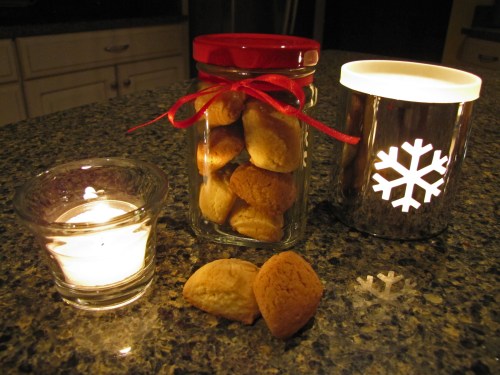
Pebbernødder hygge

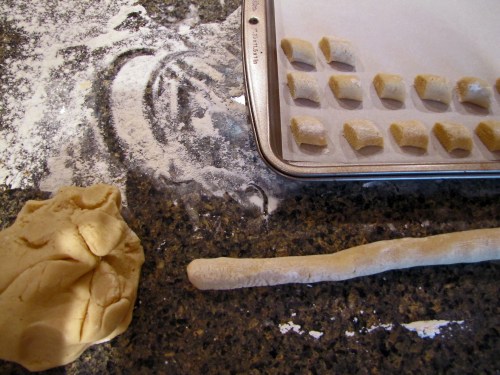
Pebernødder dough

Pebernødder

Ingredients:

80 gram salted butter (6 tablespoons)

225 gram sugar (1 cup plus 1 tablespoon)

1 egg

1 deciliter whipping cream (1/2 cup)

350 gram flour (3 cups) (add more flour if needed to bring dough together)

1/2 teaspoon baking soda

1 teaspoon ground cardamom

Directions:

Preheat oven to 225 degrees C (400 degrees F). Line baking sheets with parchment paper and set aside.

In a bowl, sift together flour, baking soda, cardomom and set aside.

In your mixer using the paddle attachment, mix together butter and sugar until creamy and smooth. Add egg and mix. Then add whipping cream and mix. Add the sifted dry ingredients to the wet ingredients and mix just until combined. Remove dough from mixing bowl onto a floured surface. Using your hands bring dough together, adding a little more flour if needed until it holds together and forms a ball. Divide dough into smaller pieces and roll into long rolls measuring the width of your fingers. Cut into 1 1/2 centimeter pieces. Place on baking sheets about 1 inch apart and bake for approximately 12 minutes until just turning golden.

Glædelig Jul and Merry Christmas♥

Pebbernødder Christmas parade

Source: Faster Philip

Print

Read Full Post »

Sparkling Linzer Stars

Sparkling Linzer Stars

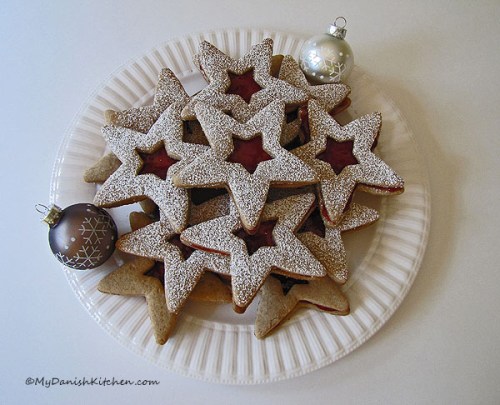
I first saw the Sparkling Linzer Star recipe in Better Homes and Gardens magazine many years ago. The cookies are so festive and Christmasy and the process of assembling them is a lot of fun.  The recipe calls for both regular flour and whole wheat flour which makes it a little healthier, but I suppose you could just use all-purpose flour if you’re not into that sort of thing. Make sure to use a generous portion of seedless raspberry jam to increase the “delish” factor.

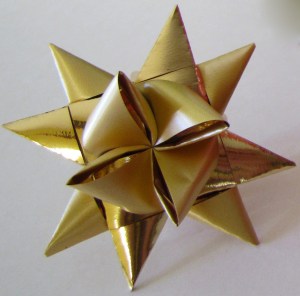
Flettede julestjerne

Danish Christmas Tradition: Juletræet (The Christmas Tree)

The Christmas Tree tradition has very old roots dating back to at least St. Boniface of Geismar, Germany. There are so many variations of this tradition depending on where in the world your located. In Danmark it’s tradition to put up and decorate the tree on Dec 23rd, although a lot of people now wish to put the tree up earlier. My parents would decorate the tree in the evening of the 23rd (little Christmas Eve) after my siblings and I were sent off to bed. The excitement was so intense that I could barely sleep and waking up to see the beautiful tree the following morning was almost magical. Old tradition for the Danish Christmas Tree is to decorate it with live candles, small Danish flags on a string, the children’s homemade braided paper hearts (flettede hjerter), paper cones (kræmmerhuse), braided stars (flettede stjerner) and some glass bulbs. Christmas in Denmark is celebrated on the eve of Dec 24th. The day of the 24th is spent waiting in anticipation, snacking on fruits, nuts and candy. A light but extra delicious lunch. Family oriented Christmas programs are on TV to help pass the time and finally after a spectacular dinner the time has come. It is time to form a circle around the tree, holding hands and sing Christmas hymns and Christmas songs while dancing around the Christmas tree. The tradition of dancing around the Christmas tree dates back to approximately 1830’s and it’s a tradition seen in Denmark, Norway and Sweden. After everyone has lost their breath from singing and dancing it is finally time to open the presents. And so you see, the glorious Christmas tree plays quite an important role to help create Danish Christmas Hygge.

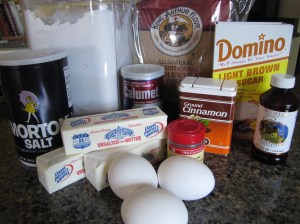
Sparkling Linzer Stars Ingredients

Sparkling Linzer Stars

Ingredients:

1-1/3 cups butter

2 cups packed brown sugar

1 tablespoon baking powder

1-1/2 teaspoons ground cinnamon

3/4 teaspoon ground allspice

1/4 teaspoon salt

3 eggs

2 teaspoons vanilla

2-1/2 cups all-purpose flour

2 cups whole wheat flour

3/4 cup seedless raspberry jam

powdered sugar (optional)

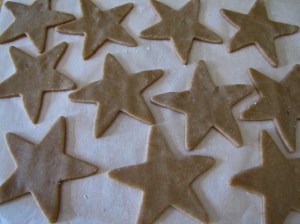
Star cutouts

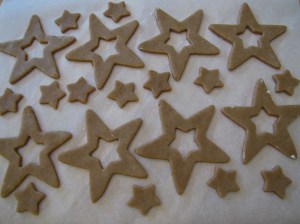
Centers cut out

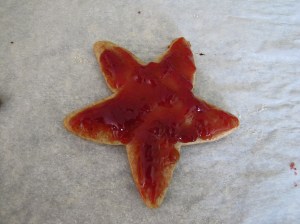
Seedless Raspberry jam

Directions:

Beat butter in a large bowl on medium speed for 30 seconds. Add brown sugar, baking powder, cinnamon, allspice and salt. Beat until combined. Add eggs and vanilla, beat until well combined. Beat in as much of both kinds of flour as you can, stir in remaining flour with a wooden spoon. Divide dough in half. Cover and chill for 1 hour or until firm enough to handle.

Preheat oven to 375 degrees F. Cover cookie sheets with parchment paper. Roll each portion of dough on a floured surface until 1/8 inch thick. Cut into shapes using star cutters (I used a 4 inch and a 1-1/4 inch). Transfer 4 inch cutout cookie dough to prepared cookie sheets. Using the smaller 1-1/4 inch cookie cutter, cut out center from half of the unbaked cookies; remove centers and reroll dough to make more cookies.

Bake in preheated oven for 7-9 minutes or until edges are firm and bottoms are very light brown. Transfer cookies to a wire rack, cool.

Spread the bottom of each solid cookie with a generous amount of raspberry jam. If desired, sift powdered sugar over the cookies with the cutout centers and place atop cookies with raspberry jam, sugar side up. Store in covered container at room temperature for up to 1 week.

Glædelig Jul and Merry Christmas♥

Linzer Stars

Linzer Stars

Source: Better Homes and Gardens

Print

Read Full Post »

« Newer Posts - Older Posts »