Feeds:
Posts
Comments

Archive for the ‘Danish’ Category

Havregrynskugler

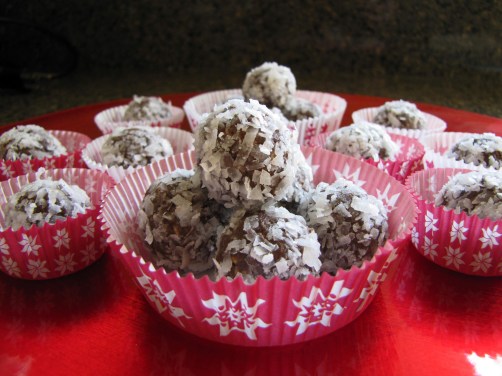
Havregrynskugler is a Danish Christmas treat that children of almost all ages can really get involved in making. They are a fun activity and super easy to make and also no-bake.

There are numerous different recipes for Havregrynskugler varying from low-fat to much richer, lower sugar to sweeter as well as adult versions containing alcohol and coffee. I like this version because it does not have a lot of butter, contains Marzipan which I love and it has a slight crunch from the sugar. If you don’t care for the sugar crunch you could substitute with confectioners sugar.

Havregrynskugler

Ingredients:

50 gram unsalted butter, at room temperature (4 tablespoons)

50 gram marzipan (1.75 ounces)

75 gram sugar (2.63 ounces)

125 gram oats (1 1/2 cups)

25 gram unsweetened cocoa (0.87 ounce or 4 tablespoons)

1 -2 teaspoon almond extract

1 -2 teaspoon rum

2 teaspoon seedless raspberry jam

about 100 gram coconut flakes, chopped finely (3.51 ounces)

Directions:

Optional: process oats in a food processor for a few pulses to break up oats a little.

In the bowl of a stand mixer fitted with the paddle attachment add butter and break marzipan into small pieces, cream together until smooth. Add sugar and continue to beat for 1 or 2 minutes longer. Add oats, cocoa, almond extract, rum and raspberry jam, continue to mix until homogeneous.

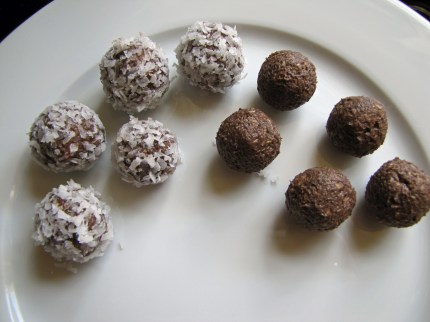
Form into small balls by pressing the dough together and rolling in your hands. Immediately roll each ball in the coconut. Place covered in refrigerator. Serve cold. Enjoy!

Source: adapted from Kvalimad

Print Friendly and PDF

Read Full Post »

Danish Træstammer

We are looooong overdue for a Danish recipe, don’t you think? There are so many recipes that I want to make (Danish and others alike)  and simply not enough hours in the day. Maybe if I took a month off from work I could make a dent in my to-do-list.

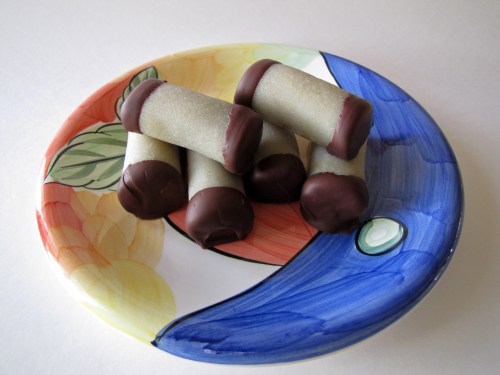
Anyway, I have been planning and researching Danish Træstammer for a long time now and I am so excited to finally being able to share them with you. I remember buying Træstammer from the store at home and they were a very special treat indeed.  For this post I choose to use a ganache as a binder which seems perhaps a little cumbersome but very delicious. Making Træstammer is not an exact science. A lot depends on how moist or dry your left-over chocolate cake is, mine was actually quite fresh and moist so it did not take much ganache to form the inside cake “batter”. The ganache portion of this recipe makes more than enough, so if you happen to have something needing decorating, the left-over ganache will be perfect.

Ingredients:

For the ganache:

2.5 deciliter (9 oz) whipping cream

250 grams (8.8 oz) dark chocolate

For the chocolate filling (logs):

400 grams (14 oz) left-over good chocolate cake

1/4 cup ganache

3 tablespoons Bacardi Gold Rum

For the outside covering:

400 grams (14 oz) marzipan

confectioners sugar for sprinkling

dark chocolate for dipping

Directions:

To make ganache: Chop the chocolate and place in a small bowl. Pour whipping cream into small saucepan and bring to a simmer. Pour the hot whipping cream over chopped chocolate and let sit for 5 minutes. Stir chocolate mixture until it’s smooth. Place in refrigerator to cool for 20-25 minutes.

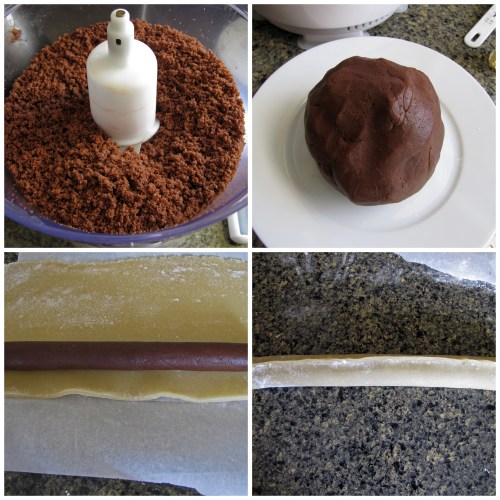
To make chocolate filling (logs): Break left-over cake into large chunks and place in food processor or blender, process until fine crumbs. Slowly add chocolate ganache, while processing, until crumbs start to come together into a ball. Add rum. Form chocolate mass into a ball and place in refrigerator.  

Sprinkle flat working surface with confectioners sugar. Form marzipan into a rectangle and start rolling it out making sure it does not stick to working surface.

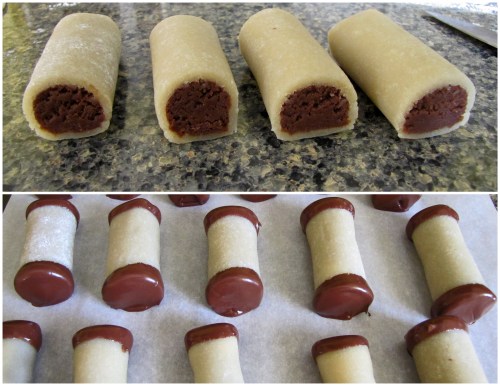
Remove the chocolate filling from the refrigerator, divide into three parts and roll each part into long logs approximately 2-3 centimeters (0.8-1 inch) in thickness. Place logs one at the time onto the marzipan and roll the marzipan around the log, cut along the long edge to fit. Pinch together the long edge to close the marzipan around the chocolate log. Gently roll the marzipan log to flatten the seam. Trim off the ends of the log, cut the logs into equal lengths approximately 7-8 centimeters (2.8-3 inches). Place cut up logs on baking sheet and place in refrigerator.

Chop the remaining chocolate, place in a small bowl over a water bath and melt. Dip each end of the logs in the melted chocolate, place on baking sheet and allow to cool. Enjoy!

Source: Himmelske Kager

Print Friendly and PDF

Read Full Post »

Easy Cheese Danish

Easy Cheese Danish

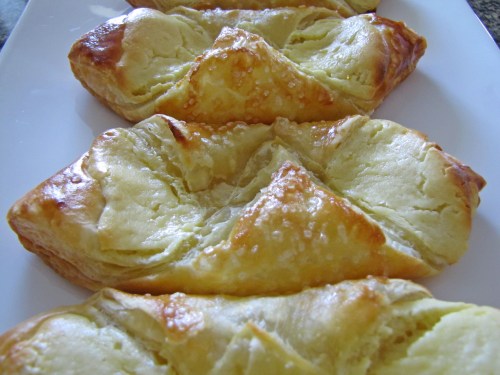
I saw Ina make these cheese Danish on Barefoot Contessa. They are easy, quick and very delicious. What’s not to like? They are wonderful served warm as well as the following day at room temperature. After the pastries are filled and folded, Ina tells you to refrigerate the pastries for 15 minutes before baking…which I failed to do. 😦 So the first four pastries I baked opened up during baking, not a pretty site (still tasted fantastic though). The next four I put in the refrigerator, as instructed, and these pastries stayed folded after baking. So I can only guess that the refrigeration of the pastries is an important step to keep the folded pastries closed during baking. I’ll remember this for next time 🙂

Ingredients:

2 sheets puff pastry (1 box)

8 oz cream cheese, at room temperature

1/3 cup sugar

2 extra-large egg yolks, at room temperature

2 tbsp ricotta cheese

1 tsp pure vanilla extract

1/4 tsp kosher salt

zest from 1 small lemon

1 egg, beaten, for egg wash

Directions:

Preheat oven to 400 degrees F. Line two baking pans with parchment paper.

Mix together cream cheese and sugar with an electrical mixer on low-speed. With the mixer still on low, add egg yolks, ricotta cheese, vanilla, salt and lemon zest, mix just until smooth. Place in refrigerator for 1 hour.

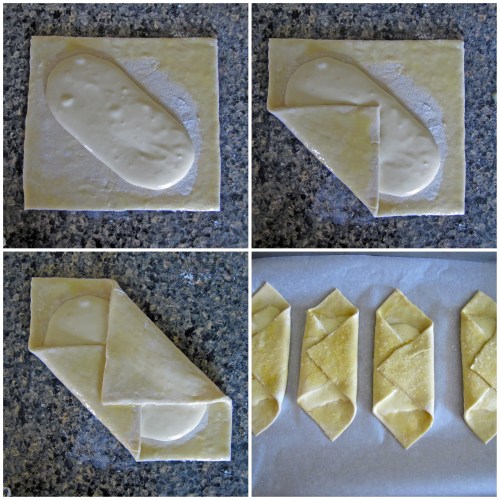
Unfold 1 sheet of puff pastry onto a lightly floured surface. If needed, roll it to a 10 x 10 inch square. Cut pastry into 4 smaller squares. Brush borders of each square with egg wash and then place a heaping tablespoon of cream cheese filling in the centers. Fold one corner gently over the filling, brush this corner with egg wash. Fold the opposing second corner over the first corner allowing the egg wash to seal the two corners together. Finish brushing the top of pastry with egg wash. Repeat with the second sheet of puff pastry. Makes a total of 8 pastries.

Using a spatula, place pastries on baking pans and refrigerate for 15 minutes. Then bake pastries for about 20 minutes until golden brown. Enjoy!

Cheese Danish

Source: Barefoot Contessa

Print Friendly and PDF

Read Full Post »

Øllebrød med Æggesnaps

Øllebrød, an almost forgotten old Danish dish? I have not had Øllebrød since I was a child and it’s a dish that I remember being served on a cold winter morning and a dish that I absolutely love. I think we may also have had it for dinner on rare occasions. It’s a dish that is great for using up the leftover end-pieces of Rye bread, but of course it doesn’t have to be leftover bread. It is high in fiber, low in fat and it has a slightly tart taste. It’s a solid meal which leaves you with a sensation of fullness and you often see it feed to babies. Ideally you want to use Rye bread without kernels but all I could find was Whole Rye bread, so in that case you simply just press the Rye Porridge (Øllebrød) through a sieve to remove the kernels. As for the topping used with this dish, it can range from milk, cream, whipped cream (flødeskum) to creamed egg topping (æggesnaps). My mother either served it with æggesnaps or milk.

Øllebrød and Æggesnaps

Now for the æggesnaps you are supposed to use pasteurized egg yolks, however, the stores around here only sell pasteurized egg whites and egg beaters. You CAN make æggesnaps with egg beaters BUT I feel weird about it because there are egg whites in egg beaters. I tried it out and the taste is different from a real egg yolk, more perfumed if that makes any sense. Why don’t they sell pasteurized egg yolks? If anyone out there has more information on pasteurized egg yolks, please let me know. Anyway, I decided to live dangerously for this one and I used a real egg yolk. I know, you’re not suppose to do that….but I did and it was fabulous. Do as I say, not as I do 🙂

Ingredients:

Øllebrød (Rye Porridge):

4 slices Rye bread, broken into pieces

cold water to cover

2 tbsp sugar

Æggesnaps (Creamed Egg):

1 egg yolk (pasteurized)

2 tbsp sugar

Directions:

To make Rye Porridge:

Break Rye bread into pieces, place in a bowl and add cold water just until covered. Cover with plastic wrap and let soak in refrigerator anywhere from 1 hour till overnight.

Pour rye bread and water into a cooking pot, simmer, stirring occasionally, until it starts to thicken. Remove from pot and place in a blender or food processor. Blend until smooth. Note: if you’re using Whole Rye bread you’ll need to strain it through a sieve to remove the kernels that don’t break down. Place back into pot and keep warm until ready to serve. If the porridge gets too thick, simply just add a small amount of water.

To make Creamed Egg topping:

Whip together egg yolk (pasteurized) and sugar until it’s thick and pale yellow (1-2 minutes). Serve Egg topping on top of warm Porridge. Enjoy.

Source: My mother Åse

Print Friendly and PDF

Read Full Post »

Kransekage

On August 23rd Joseph and I will be celebrating our Silver Wedding Anniversary, 25 years together with my Soulmate, my Best Friend and the Love of my Life. When I first met Joseph on that bus stop in Danmark and he looked at me and smiled, my life changed forever. Our lives together has been an adventure that I could never have imagined, not even in my wildest dreams.

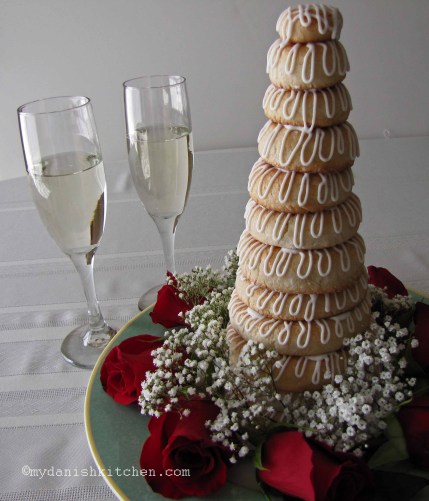
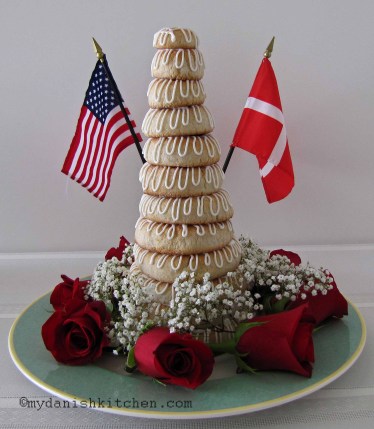
Our wedding was held in Denmark and it was a small intimate affair filled with Danish customs, lots of singing , great food and drinks. It was a really fun wedding and the last of the guests did not leave until 4 am the following morning. The wedding cake we had was not anything like the big, beautiful American style wedding cakes you see today but rather a simple, yet elegant, classic Danish festive cake. The cake is called a Kransekage and it is used for festive events like weddings, baptisms and it is typically also served on New Years Eve. It is made with Marzipan and it’s crisp on the outside and soft on the inside.

My husband Joseph was the one who suggested that I should make our wedding cake for our 25th Wedding Anniversary. My first instinct was “no way! that’s much too complicated and involved”. But of course, then I got curious and so I started looking around to see what I could find and eventually I saw Mette Blomsterberg’s TV show “Det Søde Liv” and she made it look soooo easy. And really when you think about it, it’s not that complicated, but all technique and a lengthy process.

Ingredients:

Cake:

500 gram Marzipan (cut into slices)

150 gram confectioners sugar

40 gram pasteurized egg whites

Glaze:

75 gram confectioners sugar (sifted),( plus more if needed)

30 gram pasteurized egg whites

Directions:

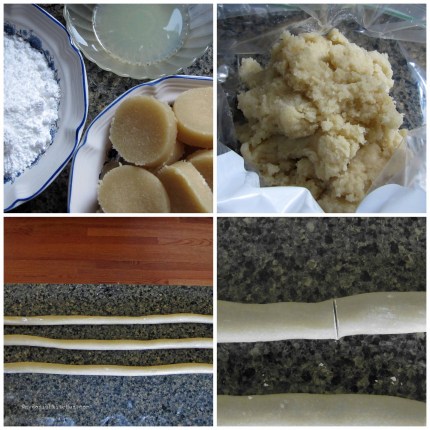
For the Cake: In a stand mixer with the paddle attachment, place 150 grams confectioners sugar and half of the pasteurized egg whites. Start the mixer on low and add marzipan pieces one by one and the remaining egg whites. When the cake mass is homogeneous, remove from mixer and place in a zip lock bag. Store in refrigerator for at least 2 hours but preferably until the following day.

Double up two large baking sheets for extra insulation to avoid burning the bottom of cake. Use parchment paper.

Note: when rolling out marzipan, wash and dry your hands as often as needed to avoid them getting sticky. Divide marzipan mass into 250 grams portions. If marzipan feels a little sticky use a small amount of confectioners sugar to roll is into logs. Roll each portion into an 80 cm long log that’s even in thickness. Lightly tap the log with the palm of your hand along the edge towards you, to form a slight soft triangular-shaped log. Using an icing spatula or a regular spatula loosen marzipan from tabletop by pressing down hard while sliding spatula under the log. Measure off marzipan into exactly 8 cm, 10 cm, 12 cm, 14 cm etc until all marzipan is used up. Don’t forget to make sure there is a little leftover marzipan to form the round top for the cake.

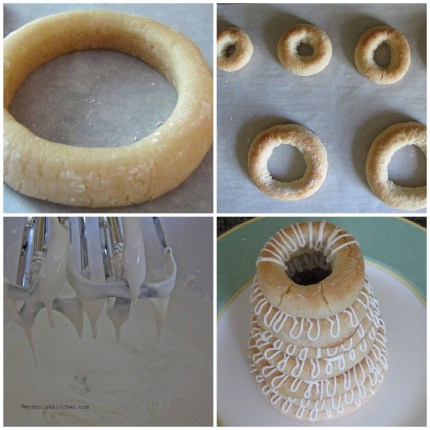
Each measured out piece of marzipan is now formed into rings, pressing gently at the seam. Place on baking sheet lined with parchment paper. Using the left over marzipan, roll a small ball that fit on top of the smallest ring, and press it slightly flat. When all rings are formed, use another baking sheet to gently press down on top of all ring to ensure they have the same height. Bake in a preheated 200 degree C (390 degree F) oven for 14 to 18 minutes. Carry in mind that the larger rings may need a little more baking time. Place rings on a rack to allow cooling completely.

For the glaze: Beat together sifted confectioners sugar and pasteurized egg whites on high-speed for at least 5 minutes. The glaze should be pretty thick and no longer flow together when beaters are stopped. Add more sifted confectioners sugar as needed. Load glaze into a decorating bag fitted with a size 2 round tip or make a cone out of parchment paper or use a plastic bag and cut a very tiny hole at the tip.

Place the largest ring on your serving plate. Begin decorating, moving the tip back and forth across the ring making sure to extend the tip out over the edge of ring to allow the glaze to droop down the outside in a loop style fashion. Place the second largest ring on top of the first ring and continue decorating, repeating until the smallest ring. Top cake off with the flattened ball on top. Allow glaze to dry at room temperature for a couple of hours before covering with plastic if cake is to be served in the following days. Enjoy.

Kransekage

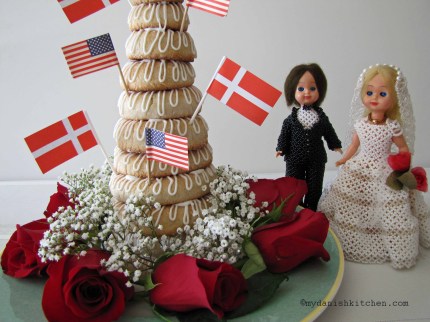
My uncle Harald made the bride and grooms wedding clothes from tiny glass pearls. To this day he still gives me small pearl figures and designs. Amazing 🙂

Kransekage

Source: Det Søde Liv – Mette Blomsterberg

Print Friendly and PDF

Read Full Post »

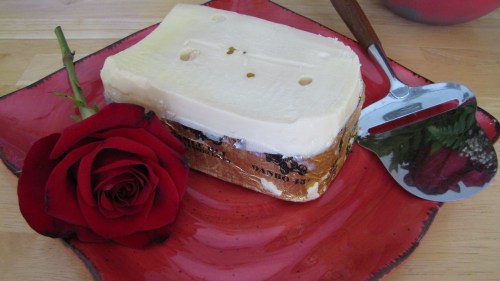
Gamle Ole aka Stinky Cheese

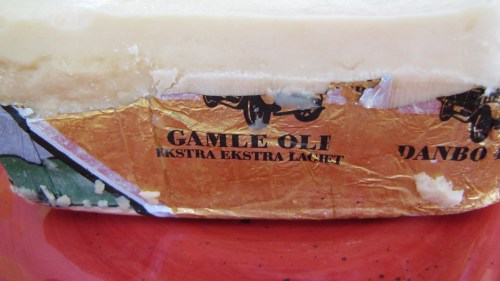
Let me introduce you to my little friend, my childhood friend, Gamle Ole aka Stinky Cheese. This is a Danish cheese which is aged 40+ weeks and it taste AMAZING and I absolutely LOVE it. It’s a very sharp cheese and as the name indicates it’s very aromatic. When I bring it out my son makes sure windows and doors are flung wide open…I guess that means it needs air to breath…no? 

Gamle Ole Danish Cheese

My parents mailed me this cheese for my birthday. It was what I had wished for and I was so happy when it arrived in the mail. I posted about it on Facebook and my cousin Anita told me a story about how her In-laws kept their Gamle Ole outside in the mailbox so not to stink up the refrigerator, besides the mailman always delivered the mail directly to their door. One day there was a substitute mailman and you can imagine his surprise to find the cheese sitting in the mailbox. 🙂

I don’t keep my Gamle Ole outside in the mailbox as I am sure the Virginia heat would melt it away, but instead its securely wrapped in two layers and stored in a Tupperware container so it wont contaminate the entire fridge. I only eat Gamle Ole on weekends because I am sure my coworkes would not appreciate the aroma of, what my son calls “smelly feet”. But despite all the talk of how badly it smells, the taste is incredible. Denmark has long had a reputation of producing award winning cheeses and Gamle Ole is no exception. It won the Best Scandinavian Cheese award in 2010. It remains a controversial cheese meaning in short that you either love or hate it…as for me, I simply just LOVE it.

Beauty and the Beast

 Source: My Danish Kitchen

Read Full Post »

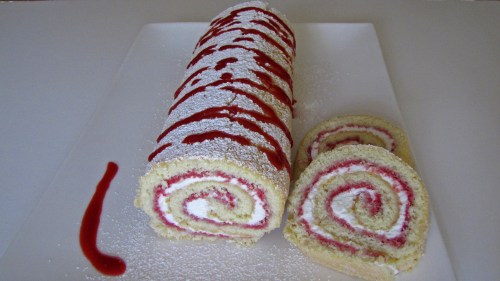
Hindbærroulade – Raspberry Swiss Roll

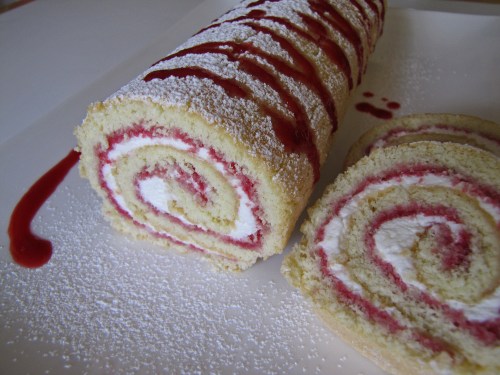
Roulade is one of my (many) favorite cakes and my mother used to make a fantastic roulade with a raspberry cream. I wanted to make some version of her cake and this is what I came up with.

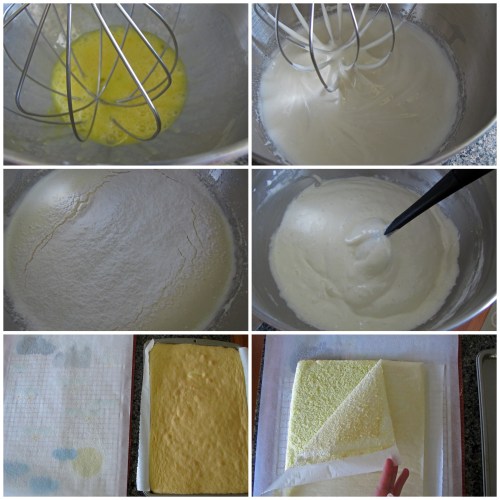
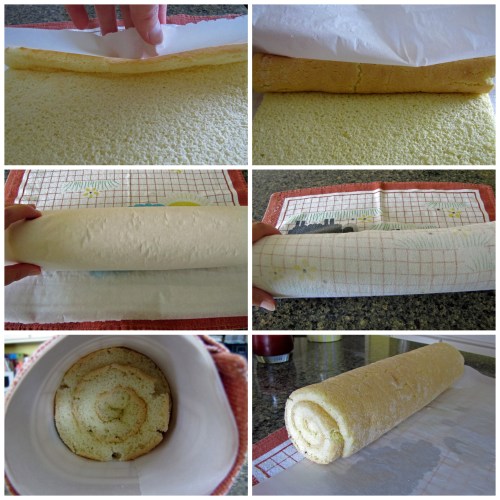
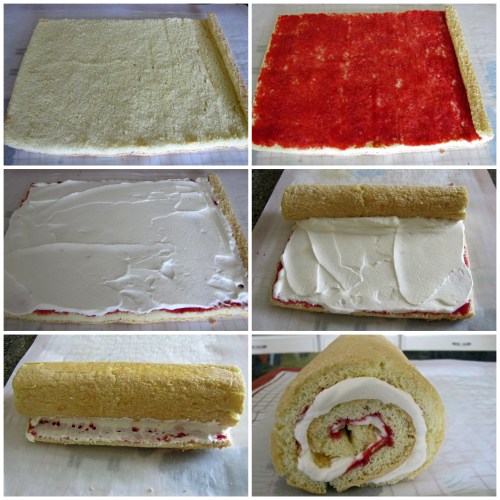
Roulade can be a very intimidating dessert to make, I know I felt a bit anxious about it myself. I did a lot of research online and planned my adventure for weeks. It turns out that there are numerous techniques out there on how to roll the cake without it cracking. Some choose to cover the cake with a moist clean tea towel while it cools and the roll it, some brush it with a liqueur or simple syrup, allow to cool and then roll it. I choose to roll it while still hot, allow to cool, unroll, apply wet ingredients and re-roll. It worked out really great. Use the parchment paper to help you roll the cake while it’s hot and get a good grip on the cake, as if you were rolling sushi. If the cake is tightly rolled, it’s easy to cut and it looks great. This turned out to be a really fun project, not to mention delicious.

Make sure to beat eggs for a full 10 minutes. Sift and fold in dry ingredient. Flip baked cake onto sugared parchment paper.

Use paper to help roll the warm cake along short edge. Get a good grip. Wrap in paper and tea towel, allow to cool.

Gently unroll cooled cake, apply wet ingredients, re-roll. Place seam-side down.

Hindbærroulade – Raspberry Swiss Roll

Ingredients:

For the cake:

3 large eggs

125 g sugar (4.4 oz) (3/4 cup)

60 g flour (2.1 oz) (1/2 cup)

60 g cornstarch (2.1 oz) (1/2 cup)

1 tsp. baking powder

For the filling:

Raspberry sauce or your favorite marmalade

225 ml heavy whipping cream (1 cup) (1/2 pint)

1 1/2 tbs. confectioners sugar

Directions:

Preheat oven to  390 degrees F   [200 degrees C]

Make Raspberry Sauce, if using, and set aside to cool.

Line a 26×36 cm (10×15 inch) baking sheet with parchment paper. Place eggs and sugar in the bowel of an electrical mixer and mix on high-speed for 10 minutes until eggs are pale and thick. Mix dry ingredients in a small bowel and sift over egg mixture. Gently fold in the dry ingredients, careful not to deflate the dough by over mixing. Pour batter onto baking sheet and gently spread out dough into all corners. Bake for 8-10 minutes until light golden. Do not over-bake, cake should spring back when touched in the center.

Place a clean tea towel on table top and lay a second piece of parchment paper on top. Sprinkle parchment paper generously with sugar. Once cake is out of the oven and still hot, flip cake out of baking sheet onto new sugared parchment paper. Carefully peel off old parchment paper. While still hot, start at the short edge and use the parchment paper to help you roll up the cake. Once starting to roll, keep a firm grip on the cake (as if you were making Sushi) to get a tight roll. Once the cake is rolled up, finish by rolling the parchment paper around the cake and then roll the tea towel around the parchment paper. Let it cool completely.

Whip whipping cream and confectioner’s sugar until it starts to thicken a little, set aside. Once cake is cooled, gently unroll. Spread a thin layer of Raspberry Sauce or marmalade out over the entire cake. Next spread a thin layer of the whipped cream. Gently roll the cake back up again with the parchment paper and store in refrigerator until ready to serve, seam side down. Enjoy.

Hindbærroulade

Source: inspired by Familie Journalen

Print Friendly and PDF

Read Full Post »

Lagkage med jordbær og marcipan

I have been meaning to make a real Danish Lagkage for quite some time now, but for some reason, I kept putting it off.  Then I went to my friend Tina’s house for our monthly Danish meeting and she served the most wonderful Lagkage which really inspired me.  The following morning I started researching Danish Lagkager and by late afternoon I had made my first ever real Danish Lagkage. The combination of fresh strawberries, crisp macaroons, sweet marcipan and light sponge cake made for an amazing combination of flavors and textures. It turned out to be a big success and it will definitely not be the last time that I make Danish Lagkage for dessert.

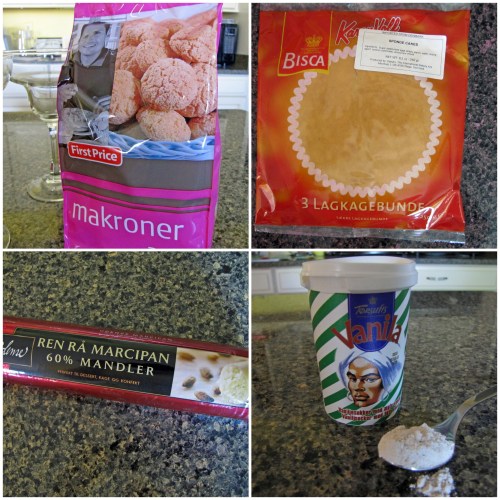
It can seem a little complicated to get all the right ingredients together but you can buy the sponge cake, Danish macaroons and raw marcipan on the internet and making the homemade custard really is very easy. I could have baked a sponge cake myself and cut it into thirds but this particular store-bought cake it very light and thin and actually perfect, in my opinion, for making a Lagkage. If you feel inspired to make a Lagkage, I am confident that you will not regret it.
Ingredients:

3 round sponge cakes

Custard:

2 eggs

2 tbsp sugar

1 tbsp cornstarch

1 cup milk (2 1/2 dl)

1 tsp vanilla sugar

Strawberry filling:

1 pint whipping cream (1/2 liter)

1 tbsp confectioner’s sugar

1 lb fresh strawberries (500 g)

Other fillings:

1/2 lb marcipan (250 g)

Confectioners sugar for rolling out marcipan

Danish macaroons – crumbled

small amount of chocolate – grated or shaved, for decoration

Directions:

To make the Custard – Whisk eggs, sugar and vanilla sugar together in a small cooking pot. Measure out milk and add cornstarch, stir to combine. Add milk to eggs in cooking pot and while stirring constantly bring to a simmer. Custard will thicken rapidly and once you notice it bubbling remove from heat. Place custard in small dish, cover with cling wrap directly onto the custard surface to avoid a skin from forming. Place in refrigerator to cool down a little.

To make Strawberry filling – Clean strawberries under running water, cut top off and cut into half, set aside. Using an electrical mixer, whisk whipping cream until it starts to thicken a little (the beaters leave a soft track in cream). Add confectioners sugar and whisk just a little more, careful not to get whipping cream too thick. Take a little under half of strawberries and break up using a fork. Add a little under half of whipping cream to smashed strawberries and stir to combine. Set aside. Set aside the remaining half of whipped cream and strawberries.

Take marcipan and divide into 2 equal portions, roll to a ball. Sprinkle confectioners sugar onto clean tabletop and roll out balls to flat disks approximately same size as your sponge cakes. Lift from tabletop and set aside.

To assemble cake:

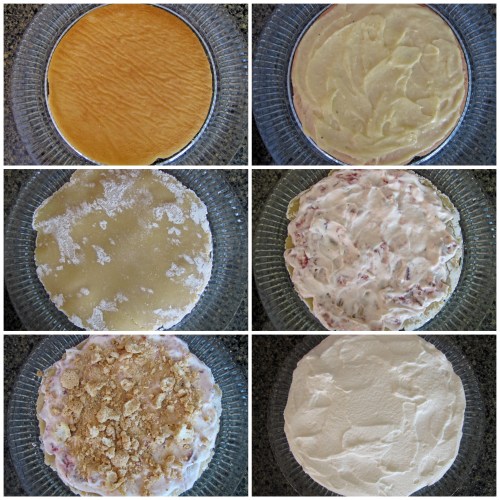
1. Place first sponge cake onto serving dish

2. Spread out half of custard

3. Add one disk of marcipan

4. Spread out half of strawberry filling

5. Add second sponge cake

6. Spread out remaining custard

7. Add second disk of marcipan

8. Spread out remaining strawberry filling

9. Crush a couple of crisp Danish macaroons and sprinkle over filling

10. Top with third sponge cake

11. Spread the last remaining whipped cream over top and sides of layered cake

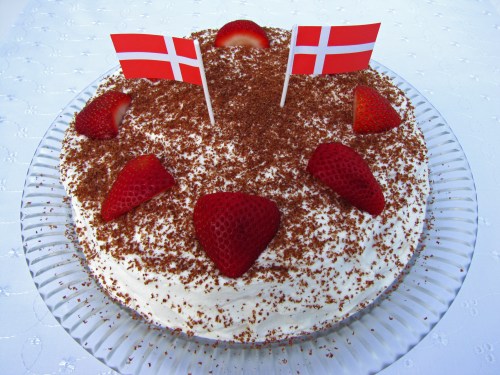
12. Decorate with grated or shaved chocolate and remaining strawberries

Keep refrigerated until ready to serve. Enjoy!

Danish Lagkage
Source: inspired by Maduniverset.dk

Print

Read Full Post »
Rabarber Koldskål

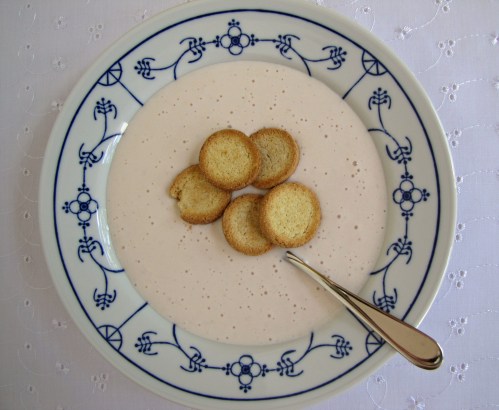
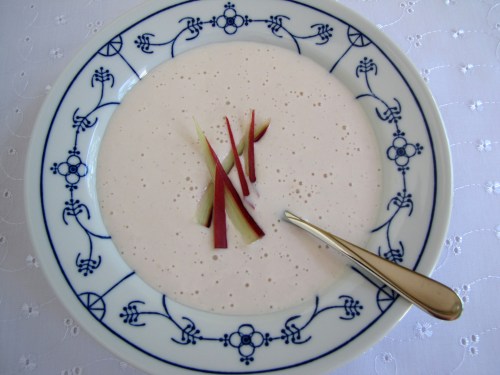
I know what you’re thinking, and your right. It’s time for Koldskål! The days are longer and the temperatures are rising and Koldskål is just such a perfect dish for summer evenings. This version is made with rhubarb which makes it a little more tart but you can always add more sugar if you like. I like the tang though. I also chose to used Greek yogurt which made it a little thicker, yet it turned out with a wonderful “airy” consistency which I really enjoyed. When ready to serve make sure you serve it very cold and with your favorite topping. I hope you enjoy this Danish summer dish.

Koldskål – 3 servings

Ingredients:

2 cups buttermilk

1 cup Greek plain non-fat yogurt

4 tablespoons sugar

Rhubarb Compote:

1 1/2 large Rhubarbs

4 tbsp sugar (50g)

1/2 vanilla bean

1/2 cup cold water (1 dl)

Topping:

Kammerjunkere – delicious cookies typically served with Koldskål

Direction:

Beat buttermilk, yogurt and sugar together. Cover and place in refrigerator.

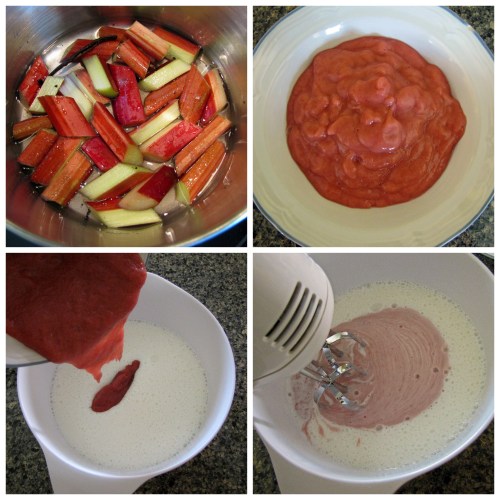
Meanwhile, clean and cut rhubarbs into 2 inch slices and place in small cooking pot. Add sugar, seeds plus vanilla bean and water. Simmer covered for 15 minutes, uncover, turn off heat and let stand another 5 minutes. Remove vanilla bean ,place in blender and blend until smooth. Allow to cool before whipping it into the Koldskål. Place back in refrigerator until ready to serve. Add your favorite topping. Enjoy.

Rabarber Koldskål med Kammerjunkere

Adapted from: Det Søde Liv

Print

Read Full Post »
Rød Grød Med Fløde

The word Grød describes the consistency of a dish, once cooked, and can be made of rice, oat, corn, potatoes, wheat, rye,  fruit etc. Grød (aka Porridge) has been a popular food in Northern Europe and Russia since the 1900 and was commonly used as a prison food in the UK. It is known to be inexpensive, easily digestible and to provide a long sensation of fullness.

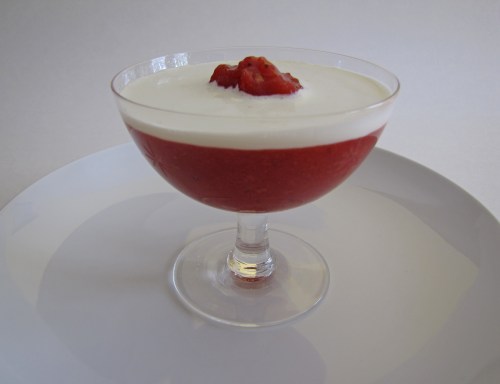
In Denmark “Rød Grød med Fløde” describes a classic summer dish made of cooked red berries served with ice-cold cream or milk. It can be made with several different types of berries or simply just with a single berry. Some of the more popular berries used include raspberries, strawberries, red currant, black berries and rhubarb (although not a berry). Rød Grød is a delicious and refreshing summer dessert which can be served either warm or cold and it is really quick and easy to make. I hope you enjoy this classic Danish dish.

Ingredients:

2 rhubarb

1 lb strawberries

6 oz raspberries

1 cup water

1/2 cup sugar

3 tbsp cornstarch

cold water

Cold cream or milk for serving

Directions:

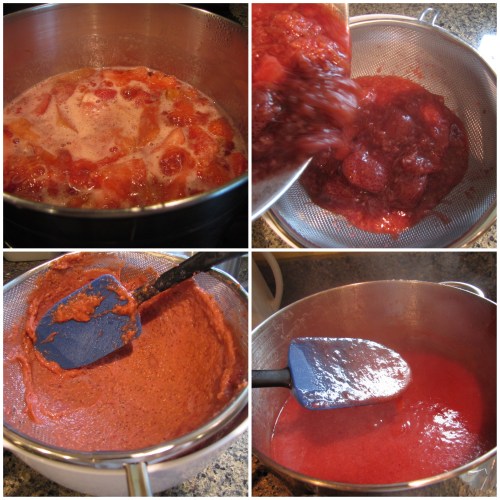
Clean rhubarb under cold running water, cut into 2 inch pieces. Rinse off strawberries, cut off top and slice in half. Look over raspberries for dirt. Place rhubarb, strawberries and raspberries in a cooking pot, add water and sugar. Simmer covered over medium-low heat for 15 minutes. Pour cooked fruit into a sieve and press fruit through the sieve using the backside of a large spoon until only seeds remain. Make sure to scrape the thick fruit pulp from the underside of the sieve, that’s the good stuff.

Stir together cornstarch and a small amount of cold water to make a slurry. Return the fruit pulp/juice to the cooking pot and bring back to a simmer. Add cornstarch slurry in small increments to the fruit while stirring, simmer. The consistency of the fruit mixture should be thick enough to cover a spoon.

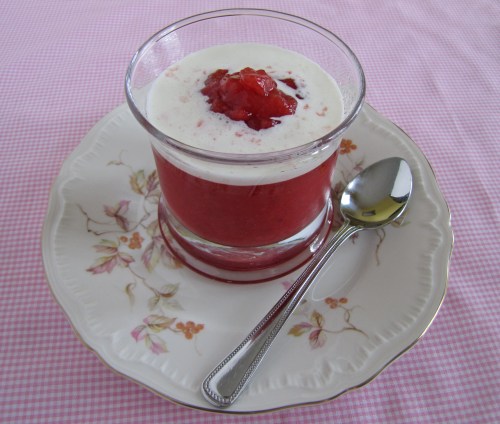
Pour fruit into small serving glasses or into a serving bowl. Place in refrigerator to cool completely. When ready to serve, pour a small amount of cold cream or milk over fruit and enjoy.


Rød Grød Med Fløde

Source: My Danish Kitchen

Print

Read Full Post »
« Newer Posts - Older Posts »